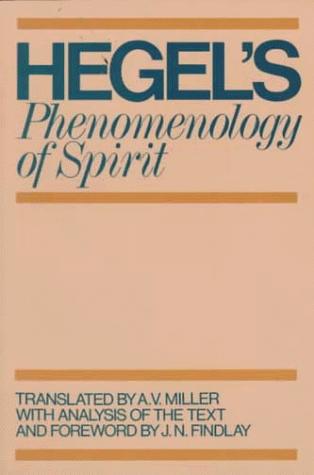
Hegel's 1807 magnum opus tracing the dialectical journey of consciousness through successive shapes — sense-certainty, perception, understanding, self-consciousness, reason, spirit, religion, absolute knowing — toward the recognition that subject and substance are one. The famous master-slave dialectic, the unhappy consciousness, and the analysis of the Enlightenment and the French Revolution sit inside this sweeping architectonic. The prose is notoriously demanding; Hegel completed it under deadline pressure as Napoleon's troops advanced on Jena.
One of the most consequential philosophical works of the modern era — the indispensable text for understanding 19th-century continental thought. The source from which Marx, Kierkegaard, Nietzsche, the Frankfurt School, French existentialism (Kojève's Paris seminars on this book trained Sartre, Lacan, and Merleau-Ponty), and contemporary recognition theorists all depart. A. V. Miller's 1977 Oxford translation has been the standard English version for nearly fifty years, with newer translations by Pinkard (2018) and Inwood (2018) entering the field.
The bud disappears in the bursting-forth of the blossom, and one might say that the former is refuted by the latter; similarly, when the fruit appears, the blossom is shown up in its turn as a false manifestation of the plant, and the fruit now emerges as the truth of it instead.
Preface
Contents
Preface
Introduction
A. Consciousness (Sense-Certainty; Perception; Force and the Understanding)
B. Self-Consciousness
C. (AA.) Reason
C. (BB.) Spirit
C. (CC.) Religion
C. (DD.) Absolute Knowing
Reception
One of the most consequential philosophical works of the modern era — the indispensable text for understanding 19th-century continental thought, the source from which Marx, Kierkegaard, Nietzsche, the Frankfurt School, French existentialism (Kojève's Paris seminars on this book trained Sartre, Lacan, Merleau-Ponty), and contemporary recognition theorists (Honneth, Pippin, Pinkard) all depart. A. V. Miller's 1977 Oxford translation has been the standard English version for nearly fifty years, with newer translations by Pinkard (2018) and Inwood (2018) entering the field. Reading communities range from neo-Hegelian analytic philosophers to Marxist theorists to theologians, all working from the same dense source.
Frequently asked
What is the Phenomenology of Spirit about?
It traces the dialectical journey of consciousness through successive shapes — sense-certainty, perception, self-consciousness, reason, spirit, religion — toward Absolute Knowing, where subject and substance are recognised as one. Each shape of consciousness encounters a contradiction that forces it to pass into a more adequate form.
What is the master-slave dialectic?
A section in the Self-Consciousness chapter in which two self-consciousnesses confront each other, risking life for recognition. One submits (the bondsman), one dominates (the lord). But through labour the bondsman comes to recognise itself in its work while the lord grows dependent — so it is the bondsman who moves toward true self-consciousness. Marx, Sartre, and Kojève each built major arguments from this passage.
Why is the Phenomenology of Spirit so difficult to read?
Hegel wrote it under deadline pressure in 1806 as Napoleon's troops entered Jena. The prose is dense because Hegel refuses to separate the act of thinking from its content — each sentence enacts the dialectical movement it describes. A. V. Miller's 1977 Oxford translation (with Findlay's analysis appended) is the standard English starting point.