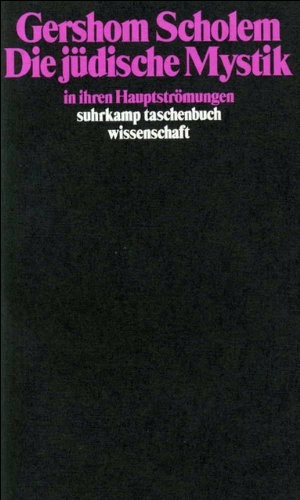
Gershom Scholem's nine-lecture survey of the Jewish mystical tradition from Merkabah and German Hasidism through the Zohar, Lurianic Kabbalah, Sabbatianism, and 18th-century Hasidism. Drawn from the 1938 Hilda Stroock Lectures at the Jewish Theological Seminary in New York, the book established academic Kabbalah studies as a discipline.
Before Scholem's work, Jewish rationalist scholars largely dismissed Kabbalah as superstition or peripheral folk religion. Major Trends argued that mysticism was a persistent and formative force in Jewish history — not a deviation but a structural counterpart to the legal tradition. The nine lectures move chronologically from the throne-mysticism of the Talmudic period through the medieval Spanish Kabbalah of the Zohar, Isaac Luria's 16th-century system in Safed, the messianic crisis of Sabbatianism, and the popular revival of Hasidism, tracing how each wave transformed the inherited vocabulary of Jewish religious thought.
Philosophy came dangerously near to losing the living God; Kabbalism, which set out to preserve Him, to blaze a new and glorious trail to Him, encountered mythology on its way and was tempted to lose itself in its labyrinth.
p. 37 · Lecture I: General Characteristics of Jewish Mysticism
First lines
It is the purpose of these lectures to describe and to analyse some of the major trends of Jewish mysticism. I cannot of course hope to deal comprehensively in a few hours with a subject so vast and at the same time so intricate as the whole sweep and whirl of the mystical stream, as it runs its course through the movements which are known to the history of Jewish religion under the names of Kabbalah and Hasidism.
Contents
Lecture I: General Characteristics of Jewish Mysticism
Lecture II: Merkabah Mysticism and Jewish Gnosticism
Lecture III: Hasidism in Mediaeval Germany
Lecture IV: Abraham Abulafia and the Doctrine of Prophetic Kabbalism
Lecture V: The Zohar I — The Book and Its Author
Lecture VI: The Zohar II — The Theosophic Doctrine of the Zohar
Lecture VII: Isaac Luria and His School
Lecture VIII: Sabbatianism and Mystical Heresy
Lecture IX: Hasidism: The Latest Phase
Reception
The founding work of academic Kabbalah studies and standard reference in any university Jewish-studies program. Moshe Idel and a subsequent generation of scholars have argued Scholem privileged certain trends — particularly Lurianism and Sabbatianism — over equally important non-theosophic mystical currents, and that his secularized framing of Kabbalah as a 'symbol of crisis' reflects his own Weimar context. The methodological critique is real; the book's status as the discipline's foundation is unchallenged.
Frequently asked
What is Major Trends in Jewish Mysticism about?
It is Gershom Scholem's nine-lecture survey of Jewish mysticism from late antiquity through the 18th century, covering Merkabah mysticism, the medieval German Hasidic movement, the Kabbalah of the Zohar, Lurianic Kabbalah, Sabbatianism, and the Hasidism of the Baal Shem Tov. Delivered as the Hilda Stroock Lectures in 1938, it became the founding text of academic Kabbalah studies.
Why was this book historically significant?
Before Scholem, rationalist Jewish scholars largely dismissed Kabbalah as marginal superstition. Major Trends argued that mysticism was a persistent and formative force in Jewish history, not a deviation from normative Judaism. It established the academic study of Kabbalah as a legitimate discipline and made Scholem the first Professor of Jewish Mysticism at Hebrew University of Jerusalem.
What are the main scholarly critiques of the book?
Moshe Idel argued that Scholem privileged theosophical Kabbalah — particularly Lurianism and Sabbatianism — over non-theosophic or ecstatic currents of equal historical weight, and that Scholem's framing of Kabbalah as a response to historical crisis reflected his own Weimar context rather than the primary sources. These critiques are widely accepted; the book's foundational status has not been displaced.