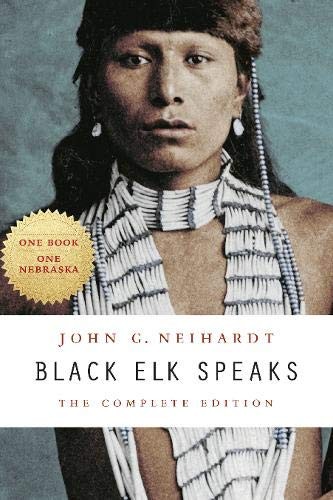
Black Elk Speaks is a 1932 autobiographical account of the visions and life of Black Elk (1863–1950), an Oglala Lakota medicine man and healer, recorded by the American poet John G. Neihardt. The book was assembled from interviews conducted on the Pine Ridge Reservation in 1930 and 1931, with Black Elk speaking in Lakota and his son Ben Black Elk translating into English. The narrative follows Black Elk from childhood through his Great Vision at age nine—a cosmological revelation in which twelve horses carry him to the sky world and he is commissioned to restore the sacred tree at the center of the Lakota world—and continues through his years as a healer, the Battle of the Little Bighorn (1876), his travels to Europe with Buffalo Bill's Wild West Show, the Ghost Dance movement, and the Wounded Knee Massacre of December 1890, which he witnessed. The book closes with Black Elk, then elderly, ascending Harney Peak and lamenting what he sees as his failure to fulfill his vision.
The book received little attention at publication but was reprinted in 1961 and gained a broad readership through the 1970s. Carl Jung read the original 1932 edition and urged its German translation, which appeared in 1955. The book's authority has been contested: Raymond DeMallie's 1985 study The Sixth Grandfather, which includes the original interview transcripts, showed that Neihardt substantially reshaped Black Elk's words for literary effect. Some Lakota scholars have questioned whether the text accurately represents Lakota belief rather than Neihardt's literary reconstruction.
Reception
Black Elk Speaks sold poorly at its 1932 publication and went out of print within a decade. Reprinted in 1961, it found a far larger audience through the 1970s counter-culture and the American Indian Movement, becoming one of the most widely read accounts of Indigenous North American spirituality. Carl Jung read the original edition in the 1930s and urged its German translation, which appeared in 1955 as Ich rufe mein Volk. The University of Nebraska Press standard edition—with a foreword by Vine Deloria Jr.—has remained continuously in print and is taught in Native American studies, religious studies, and American literature courses across the United States. Critical reassessment has been substantial: Raymond DeMallie's 1985 study The Sixth Grandfather published the original interview transcripts alongside the finished book, showing that Neihardt reshaped key passages for literary effect. Some Lakota scholars and Native American studies academics have argued that the book reflects Neihardt's literary mediation as much as Black Elk's own voice, and that certain spiritual elements may have been amplified for a non-Native audience. Despite these debates, the book remains the most widely read account of Lakota spiritual life and a canonical text in the study of North American indigenous religion.
Frequently asked
What is Black Elk Speaks about?
The book records the life and visions of Black Elk, an Oglala Lakota medicine man, as told to the American poet John G. Neihardt in 1930 and 1931. It covers Black Elk's Great Vision at age nine, his years as a healer, the Battle of the Little Bighorn, his travels with Buffalo Bill's Wild West Show, the Ghost Dance movement, and the Wounded Knee Massacre of 1890.
Who actually wrote Black Elk Speaks?
Neihardt wrote the book in English after conducting interviews with Black Elk on the Pine Ridge Reservation. Black Elk spoke in Lakota; his son Ben Black Elk translated into English and Neihardt's daughter Enid took notes. Raymond DeMallie's 1985 study The Sixth Grandfather published the original transcripts, showing that Neihardt edited and shaped the material substantially.
Is Black Elk Speaks an accurate account of Lakota belief?
The book's accuracy has been debated by scholars. DeMallie's transcript edition shows that Neihardt reshaped Black Elk's words for a non-Native audience. Some Lakota scholars and Native American studies academics have argued that certain passages reflect Neihardt's literary sensibility more than Black Elk's original speech. The University of Nebraska Press annotated edition addresses some of these questions with additional historical context.