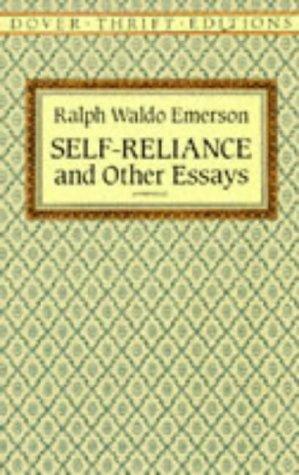
Self-Reliance and Other Essays brings together Ralph Waldo Emerson's most-read prose from Essays: First Series (1841) and Essays: Second Series (1844). The title essay argues that each person carries a private truth that society, conformity, and consistency work to suppress. Emerson's instruction is direct: trust the spontaneous impression, act from it, and refuse the pressure to explain or recant. Companion essays on compensation, the soul's unity, the creative act, and the nature of experience extend the same thread.
At the center of Emerson's project is a distinction between intuition and tuition — the difference between what you know directly and what you have been told. The Over-Soul essay frames this cosmologically: individual minds are partial inlets to a shared, impersonal intelligence. The essays were written in a period of intense engagement with German idealism, Hinduism, and English Romanticism, and they transmit those influences without the apparatus of academic philosophy.
Trust thyself: every heart vibrates to that iron string.
Self-Reliance
First lines
I read the other day some verses written by an eminent painter which were original and not conventional. The soul always hears an admonition in such lines, let the subject be what it may. The sentiment they instil is of more value than any thought they may contain. To believe your own thought, to believe that what is true for you in your private heart is true for all men, — that is genius.
Reception
The essays were read and debated from publication. Self-Reliance drew immediate criticism from orthodox religious circles for its rejection of external authority, including scripture. Among American writers the essays established a vocabulary — non-conformity, self-trust, the Over-Soul — that runs through Thoreau, Whitman, and William James. Harold Bloom counted Emerson the central figure of the American literary tradition; Barbara Packer's scholarship recovered the theological precision beneath the aphoristic surface. The most common criticism — that the essays counsel solipsistic individualism — was noted by contemporaries and persists; defenders read the Over-Soul doctrine as exactly the correction, grounding self-trust in a transpersonal rather than personal source. The Dover Thrift Edition (1993) has kept the texts in wide circulation in undergraduate courses in American literature and philosophy.
Frequently asked
What is the central argument of "Self-Reliance"?
The essay argues that each person has access to a spontaneous inner conviction — what Emerson calls intuition — and that social conformity, false consistency, and deference to authority suppress it. The practical instruction is to act from that private truth without seeking approval or justification.
What is the Over-Soul?
In the essay of the same name, Emerson describes an impersonal, shared intelligence of which individual minds are partial expressions. It functions as a secular equivalent to what theological traditions call the divine or universal spirit, and it grounds self-trust: your deepest intuitions draw on a source that exceeds your individual self.
How did these essays influence later thought?
Emerson is a direct source for Thoreau's civil disobedience, Whitman's democratic individualism, William James's pragmatism, and — through the New Thought movement — for popular self-help traditions of the twentieth century. His vocabulary of self-trust, non-conformity, and correspondence between mind and nature reappears across American philosophy, literature, and spirituality.