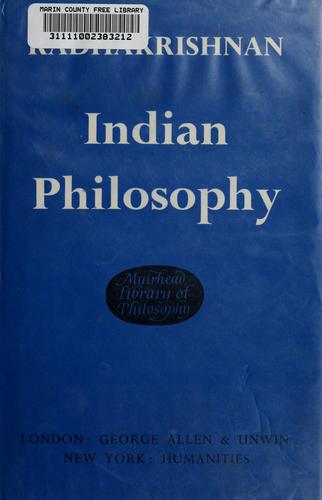
Indian Philosophy is a two-volume survey of the Indian philosophical tradition by Sarvepalli Radhakrishnan, first published in 1923 and 1927 by George Allen and Unwin. It traces the development of Indian thought from the Vedas and Upanishads through the six orthodox darśanas, Buddhist and Jain schools, and Advaita Vedānta. It was the first comprehensive scholarly English-language treatment of the field by an Indian philosopher.
Radhakrishnan reads the entire tradition through the lens of Advaita Vedānta, treating non-dualism as the philosophical culmination of Indian thought. This interpretive stance, which later scholars including J. N. Mohanty and Wilhelm Halbfass have described as Vedānta-centric and harmonising, is the work's principal limitation. Despite that, the two volumes remain a standard starting reference, continuously in print at Oxford University Press (Oxford India Paperbacks) since 1989.
It is untrue to say that philosophy in India never became self-conscious or critical. Even in its early stages rational reflection tended to correct religious belief.
p. 27 · Chapter I, Introduction
First lines
Philosophy in India is essentially spiritual. It is the intense spirituality of India, and not any great political structure or social organisation that it has developed, that has enabled it to resist the ravages of time and the accidents of history.
Contents
Introduction
The Hymns of the Rig-Veda
Transition to the Upanishads
The Philosophy of the Upanishads
Materialism
The Pluralistic Realism of the Jainas
The Ethical Idealism of Early Buddhism
Epic Philosophy
The Theism of the Bhagavad-Gita
Buddhism as a Religion
The Schools of Buddhism
Reception
The work established Radhakrishnan's international reputation and is credited with introducing serious comparative philosophy of Indian thought to English-language academia. It is read by later scholars as both authoritative survey and as a programmatic argument: Radhakrishnan reads the entire tradition through the lens of Advaita Vedānta, treating non-dualism as the philosophical telos of Indian thought, a framing later scholars (J. N. Mohanty, Wilhelm Halbfass) have flagged as Vedānta-centric and harmonizing. Despite that interpretive bias, the two volumes remain a standard starting reference and have been continuously in print at Oxford India Paperbacks since 1989.
Frequently asked
What is Indian Philosophy by Radhakrishnan?
It is a two-volume survey of Indian thought from the Vedas to Ramanuja, first published in 1923 (Vol. 1) and 1927 (Vol. 2). Radhakrishnan traces the development of Hindu, Buddhist, and Jain philosophy in English, interpreting the entire tradition through the lens of Advaita Vedānta.
Is it still a valid scholarly reference?
The two volumes remain in print with Oxford University Press and are a standard starting reference. Later scholars (J. N. Mohanty, Wilhelm Halbfass) have noted its Vedānta-centric framing, but it was the first comprehensive scholarly English-language treatment by an Indian philosopher and retains historical importance.
What does Radhakrishnan mean by "philosophy in India is essentially spiritual"?
He argues that Indian philosophy's defining feature is its orientation toward the spiritual rather than toward political structures. Philosophy in India serves as a way of life aimed at spiritual realisation, and even the most rationalist schools — including early Buddhists and the materialist Carvakas — are responses to this context.