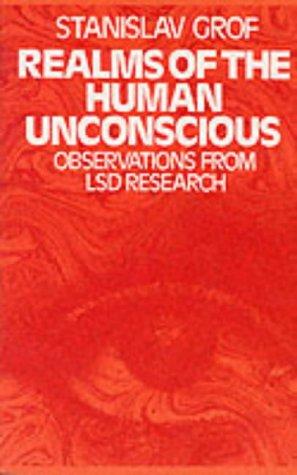
Realms of the Human Unconscious is the first major monograph by the Czech-born psychiatrist Stanislav Grof, published by Viking in 1975 and based on Grof's clinical work with several thousand LSD-assisted psychotherapy sessions conducted in Prague and at the Maryland Psychiatric Research Center between 1956 and the early 1970s. Grof organises the recurring contents of his patients' non-ordinary states into four expanding cartographic regions — the abstract and aesthetic, the biographical, the perinatal (with its four basic perinatal matrices BPM I–IV), and the transpersonal — and argues that the deeper layers cannot be reduced to biographical material in the Freudian or even the Jungian sense.
The book is the founding cartography of what Grof and Abraham Maslow named transpersonal psychology. By mapping the territory traversed in LSD sessions, Grof proposed that the human psyche reaches further than any prior clinical model allowed — into perinatal memory, ancestral experience, and states of unitive consciousness. After LSD research was legally halted in the early 1970s, the cartography Grof developed in this book became the conceptual foundation for Holotropic Breathwork, which he co-created with Christina Grof as a non-pharmacological means of accessing the same territories.
First lines
This volume is the first of a series of books in which I plan to summarize and condense in a systematic and comprehensive way my observations and experiences during seventeen years of research with LSD and other psychedelic drugs. Exploration of the potential of these substances for the study of schizophrenia, for didactic purposes, for a deeper understanding of art and religion, for personality diagnostics and the therapy of emotional disorders, and for altering the experience of dying has been my major professional interest throughout these years and has consumed most of the time I have spent in psychiatric research.
Reception
Realms of the Human Unconscious has remained continuously in print through the Souvenir Press and later MAPS-aligned reissues, and is the standard reference work for the clinical research literature on LSD-assisted psychotherapy that was halted in the United States in 1970; the 21st-century psychedelic-research revival at Johns Hopkins, NYU, and Imperial College London has cited it heavily as the largest contiguous record of pre-prohibition clinical observations. Specialist criticism has come from two directions: mainstream psychoanalysts and psychiatrists (Otto Kernberg, Sherwin Nuland in his Lancet review) have argued that Grof generalises from a small and culturally homogeneous patient sample to universal structures of the psyche, while sympathetic readers within transpersonal psychology (Ken Wilber, Michael Washburn) have argued that the perinatal-matrix framework, while clinically suggestive, is not yet integrated cleanly with developmental psychology more broadly. The book remains the principal source for Grof's later Holotropic Breathwork practice and a routine reference in psychedelic-therapy training programmes.
Frequently asked
What is Realms of the Human Unconscious about?
It is Stanislav Grof's clinical account of thousands of LSD-assisted psychotherapy sessions, organised into a four-level cartography of the unconscious: the abstract and aesthetic, the biographical, the perinatal (four basic perinatal matrices), and the transpersonal. It is the founding document of transpersonal psychology.
What are the basic perinatal matrices Grof describes?
Grof identifies four perinatal matrices (BPM I–IV) that map recurring experiential territories in LSD sessions: BPM I is the intrauterine state of undisturbed union; BPM II is the onset of contractions and felt entrapment; BPM III is the struggle and propulsion through the birth canal; BPM IV is emergence and relief. Grof argues these matrices organise deep layers of the psyche that extend beyond biographical memory.
How does this book relate to Holotropic Breathwork?
After LSD research was legally halted in the early 1970s, Grof drew on the cartography he developed in this book to design Holotropic Breathwork — a technique using accelerated breathing, evocative music, and bodywork to access the same non-ordinary states. The book provides the theoretical foundation for that practice and for Grof's subsequent writings on transpersonal psychology.