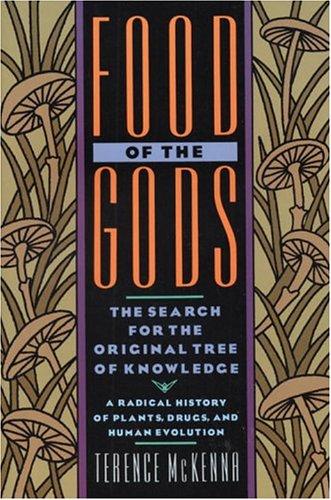
Terence McKenna's 1992 'stoned ape' thesis — that the inclusion of psilocybin mushrooms in early hominid diets accelerated the evolution of language, consciousness and culture, and that the suppression of psychedelic plants and the rise of dominator cultures can be read as a 5,000-year deviation from the species' actual lineage. The book ranges across ethnobotany, cognitive evolution and cultural history.
First lines
A specter is haunting planetary culture — the specter of drugs. The definition of human dignity created by the Renaissance and elaborated into the democratic values of modern Western civilization seems on the point of dissolving. The major media inform us at high volume that the human capacity for obsessional behavior and addiction has made a satanic marriage with the global business of drug trafficking.
Contents
Shamanism: Setting the Stage
The Magic in Food
The Search for the Original Tree of Knowledge
Plants and Primates: Postcards from the Stoned Age
Habit as Culture and Religion
The High Plains of Eden
Searching for Soma: The Golden Vedic Enigma
Twilight in Eden: Minoan Crete and the Eleusinian Mystery
Alcohol and the Alchemy of Spirit
The Ballad of the Dreaming Weavers: Cannabis and Culture
Complacencies of the Peignoir: Sugar, Coffee, Tea, and Chocolate
Smoke Gets in Your Eyes: Opium and Tobacco
Synthetics: Heroin, Cocaine, and Television
A Brief History of Psychedelics
Anticipating the Archaic Paradise
Reception
McKenna's most ambitious single book and a foundational text of psychedelic counterculture from the 1990s onward. The stoned-ape hypothesis has not gained traction in mainstream evolutionary biology — Paul Stamets has revived it, others have not — but its cultural reach has continued to grow, and Joe Rogan's persistent attention has reintroduced McKenna to a much larger audience than the original release reached. Anthropologists and historians treat the book as a creative cultural critique with imaginative ethnobotany; biologists treat it as not a serious scientific proposal.
Frequently asked
What is Food of the Gods about?
It is Terence McKenna's 1992 'stoned ape' thesis: that the inclusion of psilocybin mushrooms in early hominid diets accelerated the evolution of language, consciousness and culture, and that the suppression of psychedelic plants and the rise of dominator cultures can be read as a 5,000-year deviation from the species' actual lineage. The book ranges across ethnobotany, cognitive evolution and cultural history.
Is the stoned-ape hypothesis accepted science?
No. The hypothesis has not gained traction in mainstream evolutionary biology. Paul Stamets has revived it; most other biologists treat it as not a serious scientific proposal. Anthropologists and historians read the book as a creative cultural critique with imaginative ethnobotany rather than as established science.
Why has the book stayed in print?
It is McKenna's most ambitious single book and a foundational text of psychedelic counterculture from the 1990s onward. Joe Rogan's persistent attention to McKenna has reintroduced him to a much larger audience than the original release reached, and the book sits alongside Strassman's DMT: The Spirit Molecule and Pollan's How to Change Your Mind on the modern psychedelic-renaissance reading list.