Editor's entry
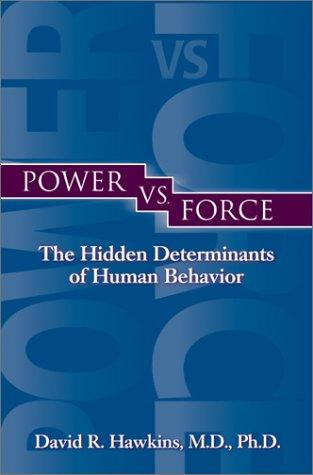
~1 min readDavid Hawkins’s exposition of his “Map of Consciousness” — a logarithmic 1–1000 scale on which he claims to have calibrated emotions, behaviours, public figures and historical periods using applied kinesiology (muscle testing). The book argues that humanity collectively crossed the 200 “integrity” threshold in the 1980s and that this calibration is empirically falsifiable.
First published by Veritas in 1995 and adopted by Hay House from 2002, Power vs. Force became the founding text of the consciousness-scale subculture. The three parts — Tools, Work, Meaning — move from the kinesiology methodology through applications in politics, sport, the arts and health, and end with chapters on what Hawkins calls the database of consciousness. Mother Teresa’s endorsement and Wayne Dyer’s repeated promotion from the early 2000s onward established its long shelf life within Hay House’s catalogue.
Themes & tags
8 totalRead / watch next
auto-computedLoading related entries…
Contents
21 chapters- Critical Advances in Knowledge
- History and Methodology
- Test Results and Interpretation
- Levels of Human Consciousness
- Social Distribution of Consciousness Levels
- New Horizons in Research
- Everyday Critical Point Analysis
- The Source of Power
- Power Patterns in Human Attitudes
- Power in Politics
- Power in the Marketplace
- Power and Sports
- Social Power and the Human Spirit
- Power in the Arts
- Genius and the Power of Creativity
- Surviving Success
- Physical Health and Power
- Wellness and the Disease Process
- The Database of Consciousness
- The Evolution of Consciousness
- The Study of Pure Consciousness
Reception
editor-collectedA foundational text of the "consciousness scale" subculture and a runaway bestseller within New Age and human-potential publishing. Wayne Dyer’s frequent endorsements during the 2000s drove a second wave of readers. Methodologically the book has been roundly dismissed: applied kinesiology has failed every blinded study it has been subjected to, and Hawkins’s calibration claims are unfalsifiable in practice. The book sits in an unusual category — central to a substantial reader community, treated as an embarrassment by adjacent science-leaning new-spirituality writers (notably Sam Harris).
Index reception note
Frequently asked
3 questions- What is Power vs. Force about?
- It is David R. Hawkins’s exposition of his "Map of Consciousness" — a logarithmic 1–1000 scale on which he claims to have calibrated emotions, behaviours, public figures and historical periods using applied kinesiology. The book argues humanity collectively crossed the 200 "integrity" threshold in the 1980s.
- Is the kinesiology methodology in Power vs. Force scientifically valid?
- No. Applied kinesiology — the muscle-testing technique Hawkins uses to derive his calibrations — has failed every blinded study it has been subjected to, and the calibration claims are unfalsifiable in practice. The book is influential within New Age publishing rather than within mainstream psychology or neuroscience.
- Why did Power vs. Force become so widely read?
- Mother Teresa’s endorsement and, from the early 2000s, Wayne Dyer’s sustained promotion through the Hay House catalogue drove a long second wave of readers. The "Map of Consciousness" framing also gave the consciousness-scale subculture a shared vocabulary that no other single book provided.
Catalogue record
- Author
- David R. Hawkins
- Title
- Power vs. Force: The Hidden Determinants of Human Behavior
- Original title
- Power vs Force
- Publisher
- Hay House
- Year
- 1 June 1995
- Pages
- 341
- Language
- English
- ISBN
- 9781401945077
- Shelf
- Consciousness · New Thought · Esoteric
Availability
By the same author
no other entriesLoading other entries by David R. Hawkins…