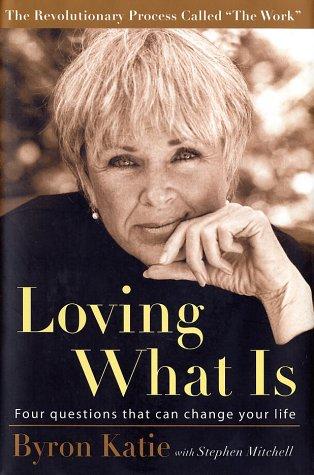
Byron Katie's foundational presentation of "The Work" — four questions and a turnaround applied to any stressful belief: Is it true? Can you absolutely know it's true? How do you react when you believe the thought? Who would you be without it? Most of the book is verbatim transcripts of Katie working live with people on their most painful beliefs about parents, partners, illness and money.
Co-written with translator Stephen Mitchell, the book was published by Harmony Books in 2002 and has been continuously in print since. A revised edition issued by Harmony in 2021 added seven new live dialogues. The four-question method has been widely adopted in therapeutic settings as an adjunct to cognitive-behavioural work.
When I argue with reality, I lose — but only 100% of the time.
Introduction
Contents
The Work
Beginning The Work
Working with Couples and Families
Working with Children
Working with Beliefs about Sex, Money, and the Body
On the Worst That Can Happen
Inquiry and the Cycle of Life
Continuing The Work
Reception
A long-running bestseller with strong word-of-mouth in therapy and recovery communities — frequently incorporated by clinicians as an adjunct to CBT despite its non-clinical framing. Praised for its elegance and for the unusual power of the live demonstrations. Critics, including several psychologists who have looked closely at the method, argue The Work can be misapplied to rationalise harmful situations (notably abusive relationships) and that the inquiry's effectiveness has not been studied in controlled trials. The pattern of strong personal endorsement from skilled practitioners alongside structural critique from clinicians has held steady for two decades.
Frequently asked
What are the four questions of The Work?
(1) Is it true? (2) Can you absolutely know that it's true? (3) How do you react — what happens — when you believe that thought? (4) Who would you be without the thought? The inquiry is then closed with a "turnaround" — restating the original thought in its opposite forms and testing whether each is at least as true.
Who is the co-author Stephen Mitchell?
Stephen Mitchell is a poet and translator best known for English versions of the Tao Te Ching, the Bhagavad Gita, the Book of Job and Rilke. He is Byron Katie's husband and the writer-collaborator on Loving What Is, A Thousand Names for Joy and A Mind at Home with Itself.
How does the book compare to cognitive-behavioural therapy?
The four-question method has been adopted by some clinicians as an adjunct to CBT, since both work by examining the believability of stressful thoughts. The Work has not been studied in controlled trials, and some psychologists have warned it can be misapplied to rationalise harmful situations such as abusive relationships.