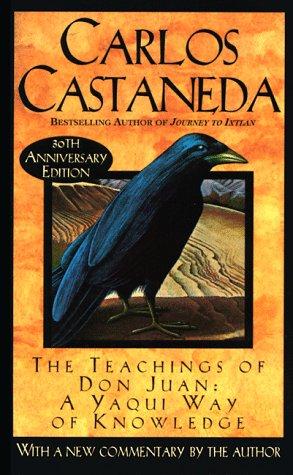
Originally Carlos Castaneda’s UCLA anthropology master’s thesis, The Teachings of Don Juan was published by the University of California Press in 1968 and recounts his apprenticeship with a Yaqui sorcerer named don Juan Matus in northern Mexico. The narrative core — "The Teachings" — is a dated sequence of field notes covering Castaneda’s use of peyote (Mescalito), Datura (jimson weed) and Psilocybe mushrooms as instruments of perception, alongside dialogues with don Juan about what Castaneda calls states of non-ordinary reality.
A second section, "A Structural Analysis", reframes the same material in the detached register of an academic anthropologist. The book is the opening volume of an eleven-title cycle that defined 1960s–70s counterculture and remained a best-seller into the 1980s. Richard de Mille’s Castaneda’s Journey (1976) and The Don Juan Papers (1980) presented detailed evidence that don Juan did not exist and that the books are fiction — a reading now broadly accepted by anthropology. UC Press has not retracted the original.
Contents
Foreword to the 30th Anniversary Edition
Introduction
Part One — The Teachings
Part Two — A Structural Analysis
Appendix A — The Operative Order of the Special Consensus
Appendix B — Outline for Structural Analysis
Reception
A defining text of 1960s–70s counterculture and one of the bestselling books published by an American university press; the eleven-book series sold in the millions through the 1980s. The reception arc has been extraordinary: Richard de Mille’s Castaneda’s Journey (1976) and The Don Juan Papers (1980) presented detailed evidence that don Juan never existed and that the books are fiction, a position now broadly accepted by anthropology. UC Press has not retracted the original. The books still sell; Yaqui scholars and Native writers have pointed out that the appropriation was harmful regardless of don Juan’s reality.
Frequently asked
What is The Teachings of Don Juan about?
It recounts Carlos Castaneda’s reported apprenticeship with a Yaqui sorcerer, don Juan Matus, in northern Mexico — including his use of peyote, jimson weed and psilocybin mushrooms as instruments of perception. The first half is a dated field-note narrative; the second half ("A Structural Analysis") frames the same material in academic anthropological language.
Was don Juan a real person?
No reliable independent evidence has ever been produced. Richard de Mille’s Castaneda’s Journey (1976) and The Don Juan Papers (1980) presented detailed textual and biographical analysis arguing that don Juan was a literary construct and the books are fiction. That reading is now broadly accepted by anthropology, though UC Press has not retracted the original publication.
Why did the book have so much influence if the anthropology is disputed?
It arrived in 1968 in the middle of the psychedelic counterculture, offered a vocabulary — "non-ordinary reality", "the path with a heart" — that travelled, and read as a serious academic monograph at a university press. The literary power and the timing carried it; the historiographical correction came later and has not displaced the book commercially.