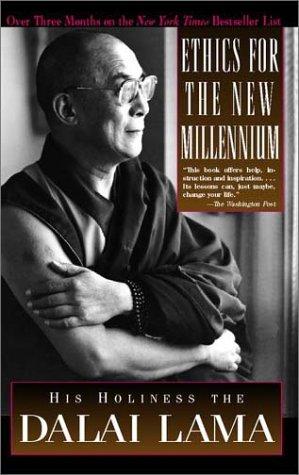
Ethics for the New Millennium (1999) is the Dalai Lama's argument for a universal ethics grounded in human interdependence rather than religious doctrine. Structured in three parts—the foundation of ethics, ethics and the individual, and ethics and society—the book contends that the aspiration for happiness shared by all people provides sufficient ground for a moral framework that transcends doctrinal differences. The analysis draws on Tibetan Buddhist understanding of mind, emotion, and interdependence, but the Dalai Lama explicitly frames his case for readers of any religion or none.
The three-part structure moves from first principles (the universality of the wish for happiness and the avoidance of suffering, the nature of interdependence) through an account of individual ethical practice (restraint, virtue, compassion, discernment) to proposals for social ethics (universal responsibility, peace and disarmament, the role of religion in public life, and a closing appeal). Throughout, the Dalai Lama treats ethical behavior not as compliance with commandments but as a trained orientation of mind and motivation.
A revolution is called for, certainly. But not a political, an economic, or even a technical revolution. We have had enough experience of these during the past century to know that a purely external approach will not suffice. What I propose is a spiritual revolution.
Part I, "The Foundation of Ethics"
First lines
I am a comparative newcomer to the modern world.
Contents
Modern Society and the Quest for Human Happiness
No Magic, No Mystery
Dependent Origination and the Nature of Reality
Redefining the Goal
The Supreme Emotion
The Ethic of Restraint
The Ethic of Virtue
The Ethic of Compassion
Ethics and Suffering
The Need for Discernment
Universal Responsibility
Levels of Commitment
Ethics in Society
Peace and Disarmament
The Role of Religion in Modern Society
An Appeal
Reception
Well received in the United States and Europe on publication in 1999, benefiting from the Dalai Lama's prominence following the 1989 Nobel Peace Prize and the success of The Art of Happiness (1998). The book has a 4.08 rating on Goodreads from over 4,500 readers. Scholars in ethics and comparative religion have noted that the "universal" framing is more accessible than philosophically rigorous—the ethical framework rests substantially on Tibetan Buddhist psychology of emotion and karma, and the transition to secular terms is less complete than the stated premise implies. The book is used in undergraduate ethics and comparative religion courses and remains in print.
Frequently asked
What is Ethics for the New Millennium about?
The Dalai Lama's argument that ethical behavior need not be grounded in religious doctrine. Starting from the observation that all people share the aspiration for happiness and the wish to avoid suffering, the book constructs a moral framework in three parts: the foundations of ethics, individual ethical practice, and social ethics including universal responsibility and peace.
Do you need to be Buddhist to benefit from this book?
No. The Dalai Lama explicitly frames his case on shared human experience rather than Buddhist doctrine, making it accessible to readers of any religion or none. He draws on Tibetan Buddhist analysis of mind and emotion throughout, but presents it as empirical observation rather than as doctrine requiring belief.
How does this book differ from The Art of Happiness?
The Art of Happiness (1998, co-written with Howard Cutler) is a personal-advice book in dialogue form. Ethics for the New Millennium (1999) is a more systematic philosophical work: it makes a formal argument for a secular ethical framework across sixteen chapters, grouped into three structured parts. The tone is less conversational and more essayistic.