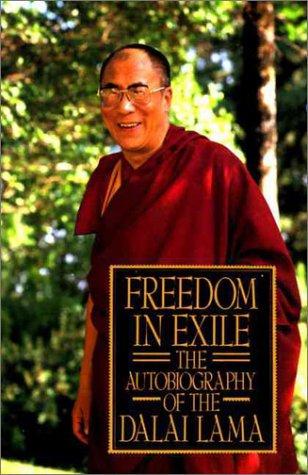
Freedom in Exile is the second autobiography of Tenzin Gyatso, the 14th Dalai Lama, published in 1990, the year after he was awarded the Nobel Peace Prize. It covers his childhood recognition as a tulku, his political education and assumption of full powers in 1950 at age fifteen, the Chinese invasion and his 1959 flight to India, and the subsequent decades of building a Tibetan government-in-exile at Dharamsala. The book is the most-cited source on his own account of those events.
The book was composed from taped interviews conducted over several years by British journalist Alexander Norman, who wrote the manuscript from those recordings. The Dalai Lama states in the introduction that he wrote it to counter Chinese claims about the history of Tibet. Its fifteen chapters move from his childhood in the village of Taktser in Amdo, through the 1950 Chinese occupation, the 1959 uprising and escape across the Himalayas to India, and his subsequent role as head of the Tibetan government-in-exile. Contested historical claims — particularly regarding pre-1959 Tibetan governance — have been noted by scholars including Tsering Shakya.
Only through the development of mutual respect, and in a spirit of truth, can friendship come about. By these means it is possible to move human minds, but never by force.
Freedom in Exile
Contents
Holder of the White Lotus
The Lion Throne
Invasion: The Storm Breaks
Refuge in the South
In Communist China
Mr. Nehru Regrets
Escape into Exile
A Desperate Year
100,000 Refugees
A Wolf in Monk's Robes
From East to West
Of "Magic and Mystery"
The News from Tibet
Initiatives for Peace
Universal Responsibility and the Good Heart
Reception
The autobiography is treated by both Tibetan-studies scholars and human-rights observers as the central first-person document of the post-1959 exile period. Sympathetic readers find in it a remarkably composed account of dispossession; critical readers — including the historian Tsering Shakya and various Chinese state historiographers — have flagged specific contested claims about pre-1950 Tibetan governance and the negotiations of the early exile years. It sold widely in the West on the back of the 1989 Nobel and helped consolidate the Dalai Lama's role as the Tibetan cause's principal global spokesperson, a role he has held for the four decades since.
Frequently asked
What does Freedom in Exile cover?
It is the Dalai Lama's account of his own life from his childhood recognition as a tulku in 1937 through the Chinese occupation of Tibet, his 1959 escape across the Himalayas to India, and three decades of leading the Tibetan government-in-exile from Dharamsala. He also discusses his evolving views on non-violence, independence, and relations with China.
How was the book written?
British journalist Alexander Norman taped extended interviews with the Dalai Lama over several years and wrote the book from those recordings. The Dalai Lama states in the introduction that his purpose was to counter Chinese government accounts of Tibetan history.
Is the book controversial?
Some historical claims — particularly about pre-1959 Tibetan governance and the early years of the exile — have been disputed by scholars including Tsering Shakya and contested by the Chinese government. The book remains the authoritative first-person account of the Dalai Lama's own experience and is widely cited in Tibetan-studies literature.