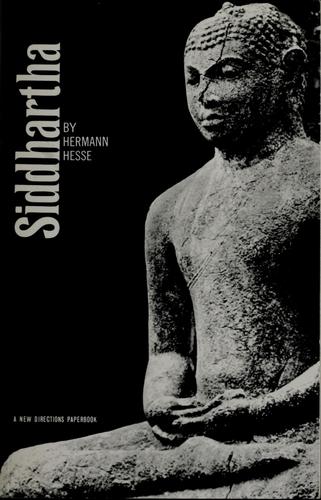
Hermann Hesse's 1922 short novel set in the India of the Buddha's lifetime, following a young Brahmin's son named Siddhartha through ascetic Samana practice, sensual immersion as a merchant and lover of the courtesan Kamala, and a final period as a ferryman on the river where he learns to listen. The protagonist meets the historical Buddha but does not become his disciple; the book's argument is that wisdom is unteachable and must be lived through.
The prose is deliberately stylised, with the cadences of scripture. Published in German in 1922, the novel reached its English-language audience through Hilda Rosner's 1951 translation and became a defining text of the 1960s American counterculture, sitting on college reading lists alongside the Tao Te Ching and Watts. Hesse won the Nobel Prize in Literature in 1946, partly on the strength of this work and Steppenwolf.
The river is everywhere at once, at the source and at the mouth, at the waterfall, at the ferry, at the rapids, in the sea, in the mountains, everywhere at once.
Chapter 9, "By the River"
First lines
In the shade of the house, in the sunshine on the river bank by the boats, in the shade of the sallow wood and the fig tree, Siddhartha, the handsome Brahmin's son, grew up with his friend Govinda.
Contents
Part One: The Brahmin's Son
Part One: With the Samanas
Part One: Gotama
Part One: Awakening
Part Two: Kamala
Part Two: Amongst the People
Part Two: Samsara
Part Two: By the River
Part Two: The Ferryman
Part Two: The Son
Part Two: Om
Part Two: Govinda
Reception
Slow to find an audience on first publication, the novel became a defining text of the 1960s American counterculture after its 1951 Hilda Rosner translation, sitting on college reading lists alongside the Tao Te Ching and Watts. Hesse won the Nobel Prize in 1946, partly on the strength of Siddhartha and Steppenwolf. Indologists have noted that Hesse's India is more Schopenhauerian than empirical and that the book's framework is closer to a German Romantic Bildung than to any historical Indian path; Buddhist teachers have generally praised it as an evocative gateway rather than a doctrinal source. Sales in English exceed several million copies.
Frequently asked
What is Siddhartha about?
Siddhartha follows a young Brahmin's son through three stages: ascetic practice with the Samanas, worldly immersion as a merchant and the courtesan Kamala's lover, and a final period as a ferryman who learns to listen to the river. The novel's central argument is that wisdom cannot be taught — it can only be lived.
Is Siddhartha the same person as the historical Buddha?
No. Siddhartha is a fictional Brahmin's son who meets the historical Gotama Buddha but does not become his disciple. Hesse uses the name and setting to explore a German Romantic theme: that each person must find their own path to wisdom, independent of any teacher.
Why did Siddhartha become so influential in the 1960s counterculture?
Hilda Rosner's 1951 English translation arrived just as American college readers were seeking alternatives to mainstream Western religion. The novel's themes of personal spiritual quest, rejection of material success, and Eastern-inflected wisdom resonated strongly, placing it alongside Alan Watts and the Tao Te Ching on reading lists of the era.