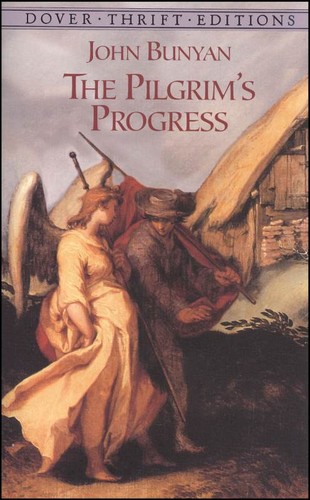
The Pilgrim's Progress is John Bunyan's 1678 Christian allegory about a man named Christian who sets out from the City of Destruction and journeys toward the Celestial City. Written in plain English and structured as a dream narrative, the book maps the Protestant doctrine of salvation through a sequence of encounters and obstacles. Christian faces the Slough of Despond, the Hill of Difficulty, the Valley of Humiliation, a combat with the demon Apollyon, the moral corruption of Vanity Fair, and the despair of Giant Despair's castle before reaching his destination. Part 2, published in 1684, follows Christian's wife Christiana and their children on the same journey, guided by Mr Great-Heart.
The allegory's method is transparent: characters and places carry names that announce their function — Faithful, Worldly Wiseman, Hopeful, Doubting Castle, the Delectable Mountains — making the theological argument accessible to readers without formal education. Never out of print since 1678, it has been translated into more than 200 languages and is commonly cited as a foundational text of English prose. Its narrative structure — the lone protagonist journeying through a hostile world toward a spiritual goal — influenced fiction by writers including John Steinbeck, Charlotte Brontë, Louisa May Alcott, and C. S. Lewis.
So he passed over, and all the trumpets sounded for him on the other side.
Part II, the passing of Mr Valiant-for-Truth
First lines
As I walked through the wilderness of this world, I lighted on a certain place where was a den, and I laid me down in that place to sleep: and, as I slept, I dreamed a dream.
Contents
The City of Destruction — Christian's Setting Out
The Slough of Despond
Mr Worldly Wiseman and the Village of Morality
The Wicket Gate and the Cross
The Interpreter's House
The Hill of Difficulty and House Beautiful
The Valley of Humiliation and Battle with Apollyon
The Valley of the Shadow of Death
Vanity Fair and the Death of Faithful
Doubting Castle and Giant Despair
The Delectable Mountains
The Enchanted Ground and Land of Beulah
The River and the Celestial City
Christiana's Setting Out
The Same Road with Mr Great-Heart
Enemies and Helpers Along the Way
Arrival at the Celestial City
Reception
A bestseller from its first publication in 1678, The Pilgrim's Progress went through eleven editions in Bunyan's lifetime and has never been out of print. It has been translated into more than 200 languages, making it one of the most widely distributed texts in history after the Bible. Its literary influence is broad: Louisa May Alcott's Little Women opens with the sisters reading it; Charlotte Brontë, Mark Twain, C. S. Lewis, and John Steinbeck drew on its imagery and structure. Critical reception has been mixed: scholars of Puritan and nonconformist literature regard it as the central work of English dissenting writing, valuing its narrative drive and plain style, while others have found its allegorical method mechanical and its theology narrow. It remains a core devotional text in evangelical Protestant communities worldwide and is largely unknown outside those contexts.
Frequently asked
What is The Pilgrim's Progress about?
It follows a man named Christian who leaves the City of Destruction and journeys toward the Celestial City. Along the way he passes through the Slough of Despond, Vanity Fair, Doubting Castle, and the Delectable Mountains. The story is a Christian allegory in which characters and places carry names that describe their spiritual significance — Faithful, Hopeful, Giant Despair, the Interpreter.
Does The Pilgrim's Progress have chapters?
The book is a continuous narrative without numbered chapters. It moves through a series of named episodes and locations as Christian travels his route. A second part, published in 1684, follows his wife Christiana and their children on the same journey, guided by Mr Great-Heart.
Is The Pilgrim's Progress still widely read?
It never went out of print after 1678 and has been translated into more than 200 languages. It remains a core devotional text in evangelical Protestant communities and appears on some literature syllabuses, but it is less commonly read outside religious contexts than it was in earlier centuries.