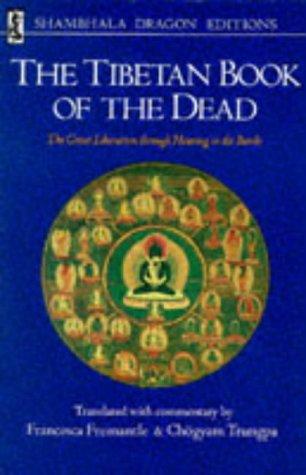
The Tibetan Book of the Dead — Bardo Thödol, "Liberation Through Hearing in the Intermediate State" — is a 14th-century Nyingma terma (revealed treasure) attributed by tradition to the 8th-century master Padmasambhava, written down by his consort Yeshe Tsogyal, and discovered by the tertön Karma Lingpa on Mount Gampodar around 1350. It is read aloud to the dying and the recently deceased as a guide through the bardos, the intermediate states between death and rebirth.
The text describes three phases of after-death experience: the clear light of awareness at the moment of death, the appearance of peaceful and wrathful deities in the second bardo, and the approach toward rebirth in the third. Each phase includes direct instruction to recognise these appearances as projections of one's own awareness and thereby attain liberation. The text is one section of a larger cycle, the Profound Dharma of Self-Liberation through the Intention of the Peaceful and Wrathful Ones.
Reception
The 1927 Evans-Wentz edition with commentary by Lama Kazi Dawa-Samdup brought the text into English and shaped its Western reception for half a century, including C. G. Jung's famous psychological commentary that read the bardos as projections of the unconscious. Later translations — Francesca Fremantle and Chögyam Trungpa (1975), Robert Thurman (1994), and especially the complete Penguin Classics edition by Gyurme Dorje (2005, the first translation of the full cycle) — corrected the Theosophical inflections of the Evans-Wentz version and re-anchored the text in its Nyingma ritual context. Western popular reception, mediated by Timothy Leary's 1964 psychedelic adaptation, often reads the bardos as inner-experience descriptions detachable from their Buddhist soteriology — a reading the tradition itself rejects.
Frequently asked
What is the Tibetan Book of the Dead?
It is a 14th-century Tibetan Buddhist text attributed to Padmasambhava and revealed by the tertön Karma Lingpa. Read aloud to the dying and recently deceased, it guides consciousness through the bardos — intermediate states between death and rebirth — with instructions to recognise visions as projections of one's own awareness.
What are the three bardos described in the text?
The text describes the bardo of dying (when a clear light of awareness appears at the moment of death), the bardo of reality (in which peaceful and wrathful deities appear), and the bardo of becoming (in which consciousness moves toward rebirth). Each stage is presented as an opportunity for liberation if recognised correctly.
Which English translation of the Tibetan Book of the Dead is most complete?
The Gyurme Dorje translation (Penguin Classics, 2005), with an introduction by the Dalai Lama, is the first complete English rendering of the full cycle. The Chögyam Trungpa and Francesca Fremantle translation (Shambhala, 1975) is widely used in contemplative practice; Robert Thurman's 1994 version is written for a general Western audience.