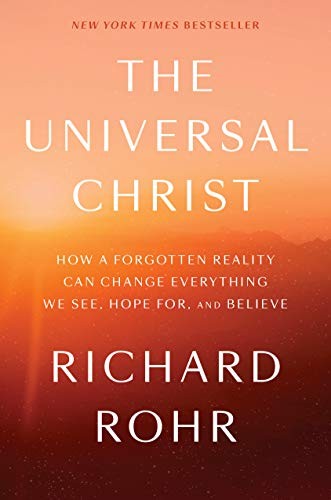
The Universal Christ is Richard Rohr's most extended treatment of Christology, published by Convergent Books in March 2019. Working from within the Franciscan tradition — particularly from John Duns Scotus's teaching that the incarnation was an act of prior divine love rather than a response to sin — Rohr argues that "Christ" names something other and larger than Jesus's surname: a pattern of divine presence woven into all of creation since the beginning. The book's organising distinction is between Jesus, the historical first-century person, and Christ, the cosmic pattern of divine self-giving that preceded that person and extends through all reality. Rohr frames this as a "forgotten reality" that can restore meaning to Christian life without requiring exclusionary claims against non-Christian paths.
The seventeen chapters move from the central thesis through treatments of original goodness, suffering, resurrection, the feminine dimension of incarnation, and the contemplative practices Rohr argues are necessary to perceive the world through this lens. The final chapter addresses practice directly, drawing on centering prayer, the Daily Examen, and what Rohr calls the discipline of seeing the divine presence in all things and persons.
God loves things by becoming them.
p. 16 · Chapter 1, "Christ Is Not Jesus's Last Name"
First lines
If you worship in one of the more liturgical Christian traditions, you probably know the opening words of the Apostles' Creed by heart: "I believe in God, the Father Almighty, creator of heaven and earth. I believe in Jesus Christ, his only Son, our Lord, who was conceived by the Holy Spirit, born of the Virgin Mary, suffered under Pontius Pilate, was crucified, died, and was buried; he descended into hell . . ." But have you ever noticed the huge leap the creed makes between "born of the Virgin Mary" and "suffered under Pontius Pilate"? A single comma connects the two statements, and falling into that yawning gap, as if it were a mere detail, is everything Jesus said and did between his birth and his death!
Contents
Christ Is Not Jesus's Last Name
Accepting That You Are Fully Accepted
Revealed in Us — as Us
Original Goodness
Love Is the Meaning
A Sacred Wholeness
Going Somewhere Good
Doing and Saying
Things at Their Depth
The Feminine Incarnation
This Is My Body
Why Did Jesus Die?
It Can't Be Carried Alone
The Resurrection Journey
Two Witnesses to Jesus and Christ
Transformation and Contemplation
Beyond Mere Theology: Two Practices
Reception
The Universal Christ debuted on the New York Times bestseller list in March 2019 and drew endorsements from Bono, Melinda Gates, and Episcopal Presiding Bishop Michael Curry. Sales were strong across Christian denominations and among readers with no formal church affiliation, making it Rohr's widest-selling book. Reception within theology was divided: admirers praised the recovery of a Teilhardian and Scotist cosmic Christology and saw it as a counterweight to what Rohr calls tribal religion; critics from evangelical and Catholic traditionalist quarters argued that Rohr's distinction between the historical Jesus and the cosmic Christ risked blurring the particularity of Christian revelation and drew more from panentheism than orthodoxy. A paperback edition was published in 2021 with a new afterword.
Frequently asked
What does Richard Rohr mean by "the Universal Christ"?
Rohr argues that "Christ" is not Jesus's last name but a title naming the divine presence woven into all of creation from the beginning. Jesus of Nazareth is the historical person who made that presence fully visible and embodied; the Christ is the pattern of divine self-giving that encompasses all of reality, preceding and extending beyond any one tradition.
How does The Universal Christ differ from orthodox Christian theology?
Rohr works from within the Franciscan tradition, specifically from John Duns Scotus's view that the incarnation was not a response to human sin but a prior act of divine love. Critics argue this framework, while rooted in one strand of Christian thought, tends toward panentheism and understates the distinctiveness of Christ's person and saving work.
What contemplative practices does Rohr recommend in this book?
The final chapter addresses practice directly, drawing on the contemplative tradition Rohr has taught throughout his career: centering prayer, the Daily Examen, and the discipline of recognising the divine presence in all things and persons — what he calls seeing "the Christ" everywhere.