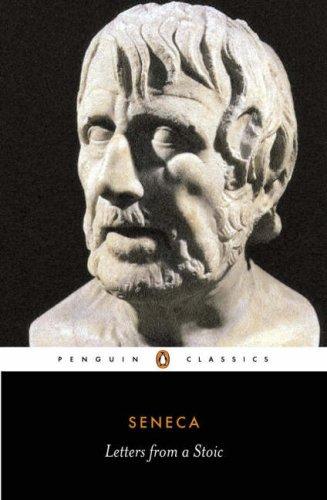
Letters from a Stoic is a selection of forty letters drawn from the Epistulae Morales ad Lucilium, the correspondence that Seneca the Younger addressed to his friend Lucilius Junior in the last two or three years of his life, around 63–65 AD. Each letter begins with a concrete observation — a gladiatorial contest, a crowded bath, a sea voyage, the noise of a gymnasium upstairs — and then works toward a Stoic principle. The recurring subjects are the right use of time, the proper attitude toward death, the meaning of friendship, the unreliability of wealth and status, and what Seneca calls the single good: virtue. This Penguin Classics edition, translated by Robin Campbell in 1969, presents forty of the original 124 letters.
Seneca is unusual among ancient Stoic writers in that he addresses himself as much as his reader. He acknowledges his own failings and inconsistencies — he was one of the wealthiest men in Rome while writing about the vanity of riches — and the letters carry that tension throughout. His style is compact and aphoristic, and many individual sentences have circulated as quotations for two thousand years. The letters have influenced writers from Montaigne to Samuel Johnson and remain one of the most widely read introductions to Stoic philosophy in any language.
Omnia, Lucili, aliena sunt, tempus tantum nostrum est. — All things, Lucilius, belong to others; time alone is ours.
Letter I, "On Saving Time"
First lines
Continue to act thus, my dear Lucilius: set yourself free for your own sake; gather and save the time which till lately has been forced from you, or filched away, or has merely slipped from your hands. Believe me when I say that time is stolen from us in part, in part filched away, and in part vanishes. But the most disgraceful kind of loss is that due to carelessness.
Contents
I. On Saving Time
II. On Discursiveness in Reading
III. On True and False Friendship
V. On the Philosopher's Mean
VII. On Crowds
XII. On Old Age
XIV. On the Reasons for Withdrawing from the World
XVI. On Philosophy, the Guide of Life
XVII. On Philosophy and Riches
XVIII. On Festivals and Fasting
XXIV. On Despising Death
XXVII. On the Good Which Abides
XXVIII. On Travel as a Cure for Discontent
XLVII. On Master and Slave
LXX. On Taking One's Own Life
LXXVII. On the Right Time to Die
LXXXVIII. On Liberal and Vocational Studies
XC. On the Part Played by Philosophy in the Progress of Man
Reception
The Epistulae Morales have been read continuously since antiquity. Michel de Montaigne modelled his Essays on them and cited Seneca throughout; Erasmus prepared a critical edition in 1529; and Justus Lipsius built his Neo-Stoicism of the late sixteenth century substantially on them. Robin Campbell's 1969 Penguin Classics selection introduced the letters to a mass paperback readership and became the standard English entry point for the latter twentieth century. The Penguin edition is often noted for its readable prose but criticised for its selectivity: only forty of the 124 letters are included, weighted toward Seneca's more accessible, moralistic writing; the later, more technical philosophical letters are largely absent. The Graver–Long translation (University of Chicago Press, 2015) has since become the scholarly standard for the complete text. The book's contemporary resurgence is partly driven by the popular Stoicism movement, which has brought the practical letters — on time, death, and the management of desire — to a wide new readership. Some scholars note that this self-help framing is a partial misreading: Seneca's ethics are more demanding than the productivity register implies.
Frequently asked
What is Letters from a Stoic about?
It is a selection of forty letters that Seneca wrote to his friend Lucilius around 63–65 AD. Each letter opens with an observation from daily life and moves toward a Stoic principle. The central concerns are time, death, friendship, the proper use of reason, and freedom from fear.
How many letters are in the Penguin Classics edition?
Robin Campbell's Penguin Classics selection includes forty of the original 124 letters. The selection emphasises Seneca's personal, practical, and moral letters; the later, more abstract philosophical letters are mostly absent. The Graver–Long translation (University of Chicago Press, 2015) includes the complete 124 letters.
Is Letters from a Stoic a good introduction to Stoicism?
It is one of the most widely read introductions, notable because Seneca writes as a practitioner working through difficulties rather than as a systematic philosopher. The letters on time (I), crowds (VII), old age (XII), and master and slave (XLVII) are among the most frequently cited. Readers who want the complete correspondence can turn to the Graver–Long translation.