The Ramayana, attributed to the sage Valmiki, is one of the two great Sanskrit epics of ancient India, the other being the Mahabharata. In about 24,000 verses across seven books (kāṇḍas), it tells the life of Rama, prince of Ayodhya and, in the developed tradition, an avatar of the god Vishnu. The narrative follows his exile to the forest, the abduction of his wife Sita by Ravana, the demon-king of Lanka, the war to recover her with the help of Hanuman and the monkey army, and his return to rule. Composed and transmitted orally over centuries, the poem has shaped the literature, art, and religious life of South and Southeast Asia, where it survives in many regional retellings. Scholars place the core of the text at roughly the fifth to fourth century BCE, with the first book and the last generally regarded as later additions; the exact dating is uncertain and debated.
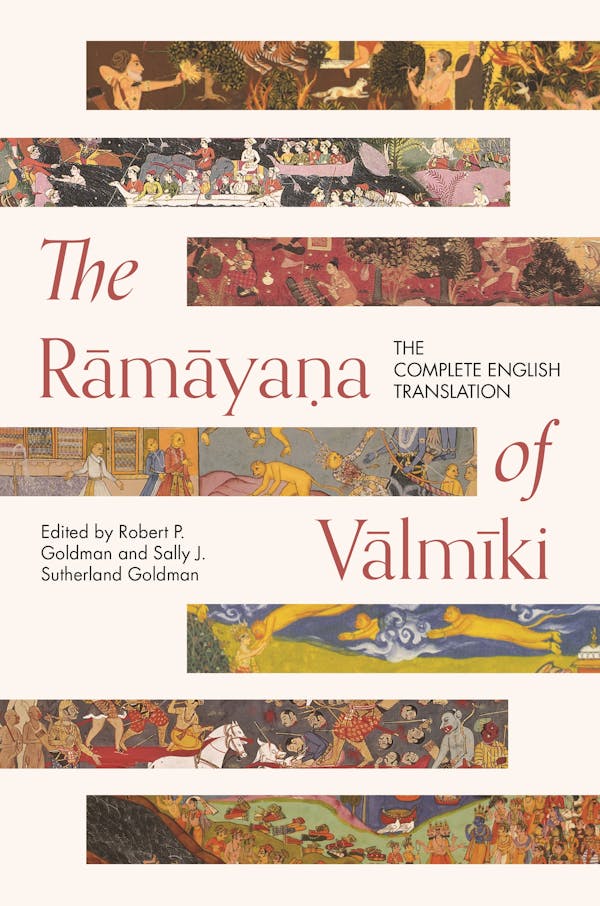
This entry refers to the Princeton one-volume Complete English Translation, edited and translated by Robert P. Goldman and Sally J. Sutherland Goldman from their seven-volume critical edition produced between 1984 and 2017. It presents the unabridged text in contemporary English prose with an introduction, glossary, and pronunciation guide. The Ramayana is read in several ways at once: as scripture and devotional text, as a foundational work of world literature, and as a record of ideals of duty (dharma) that later readers have also questioned, including Rama's treatment of Sita in the final book. It is recited and performed as much as it is studied.
Contents
Bālakāṇḍa — The Book of Boyhood
Ayodhyākāṇḍa — The Book of Ayodhyā
Araṇyakāṇḍa — The Book of the Forest
Kiṣkindhākāṇḍa — The Book of Kiṣkindhā
Sundarakāṇḍa — The Book of Beauty
Yuddhakāṇḍa — The Book of War
Uttarakāṇḍa — The Final Book
Reception
The Ramayana is among the most influential texts of the Indian tradition and is read both as sacred scripture and as literature. Its episodes are retold across South and Southeast Asia in works such as the Tamil Kamba Ramayanam, the Hindi Ramcharitmanas of Tulsidas, and the Thai Ramakien, and are performed annually in Ramlila theatre. Modern reception is not uniform: feminist and Dalit readers have questioned parts of the narrative, especially Sita's trial by fire and her later banishment, and the authenticity of the final book (Uttarakāṇḍa) is debated by scholars. The Goldman and Sutherland Goldman translation used here was named a Choice Outstanding Academic Title and was described by Wendy Doniger in the New York Review of Books as "a masterpiece of scholarship"; reviewers note that it aims at both accuracy and readability while keeping the oral, repetitive texture of the original.
Frequently asked
What is the Ramayana about?
It is the ancient Sanskrit epic, attributed to the sage Valmiki, of Rama, prince of Ayodhya. Across seven books it follows his exile to the forest, the abduction of his wife Sita by Ravana the king of Lanka, the war to rescue her with the help of Hanuman and the monkey army, and his return to rule. It is read both as Hindu scripture and as a foundational work of world literature.
When was the Ramayana written, and did Valmiki write it?
The text is traditionally attributed to the sage Valmiki, who also appears as a character within the story. Valmiki is a legendary figure, and the epic was composed and transmitted orally before being written down. Scholars place the core of the text at roughly the fifth to fourth century BCE, with the first book (Bālakāṇḍa) and the last (Uttarakāṇḍa) generally regarded as later additions. The precise dating is uncertain.
Which translation is this?
This page refers to the Princeton one-volume Complete English Translation by Robert P. Goldman and Sally J. Sutherland Goldman (2021), based on their seven-volume critical edition. It is an unabridged scholarly translation in contemporary English prose. Shorter abridged and retold versions also exist, such as those by Arshia Sattar, R. K. Narayan, and Ramesh Menon, which give the story without the full critical apparatus.