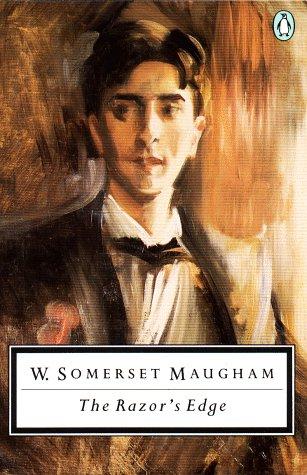
W. Somerset Maugham's 1944 novel, narrated by a fictionalised version of the author and following Larry Darrell, a young American pilot traumatised by the death of a comrade in the First World War, who rejects a conventional Chicago life — fiancée, stockbroker job — to spend years drifting through Paris, the German mines, and finally an Indian ashram, in search of a meaning the world around him does not provide. The title is taken from a verse in the Katha Upanishad: "the sharp edge of a razor is difficult to pass over; thus the wise say the path to salvation is hard."
The narrative follows Larry across a decade — from post-war Paris through Montparnasse bohemia and the Rhineland mines to Pondicherry and back — set against a cast that includes his former fiancée Isabel, the socialite Elliot Templeton, and Sophie MacDonald, a war-damaged figure who takes the opposite path. Maugham's 1938 visit to Sri Ramana Maharshi at Tiruvannamalai shaped the Indian chapters, which draw on Advaita Vedanta and the Upanishads in a way largely unprecedented in Anglophone popular fiction of the period. The book remains one of the earliest mainstream Western novels to treat Indian spiritual practice as a serious philosophical subject rather than as orientalist backdrop.
The sharp edge of a razor is difficult to pass over; thus the wise say the path to salvation is hard.
p. epigraph · Epigraph — Katha Upanishad, VI.14
First lines
I have never begun a novel with more misgiving. If I call it a novel it is only because I don't know what else to call it. I have little story to tell and I end neither with a death nor a marriage.
Contents
Part 1
Part 2
Part 3
Part 4
Part 5
Part 6
Part 7
Reception
A defining mid-century novel of Western seekership and one of the earliest mainstream American fictions to take Indian spiritual practice seriously rather than as exotic backdrop. The 1946 Tyrone Power film and 1984 Bill Murray remake kept it in popular circulation. Maugham was at the height of his commercial powers; literary reception has always treated him as a craftsman rather than an artist, and Edmund Wilson's hostile reviews of his major work set a tone that has only partly been reversed. The Indian sections, drawn from Maugham's 1938 visit to Sri Ramana Maharshi at Tiruvannamalai, have been credited and contested as accurate or romanticised in roughly equal measure.
Frequently asked
What is The Razor's Edge about?
It follows Larry Darrell, a young American pilot traumatised by a comrade's death in the First World War, who abandons his fiancée and career to spend years wandering through Paris, the Rhineland, and an Indian ashram in search of transcendent meaning. Narrated by a fictionalised W. Somerset Maugham, the novel traces Larry's decade-long spiritual journey against a backdrop of conventional Chicago society.
What does the title The Razor's Edge mean?
The title comes from a verse in the Katha Upanishad (VI.14): "The sharp edge of a razor is difficult to pass over; thus the wise say the path to salvation is hard." Maugham uses it as the book's epigraph to signal that Larry's spiritual search is genuinely difficult — not a romantic adventure but a demanding and uncertain path.
What is the connection to Ramana Maharshi?
Maugham visited Sri Ramana Maharshi at Tiruvannamalai in 1938, six years before the novel was published. The Indian chapters draw on Advaita Vedanta and the Upanishads, and Maugham's portrait of a Hindu sage is widely understood to be based, at least in part, on Ramana Maharshi. Scholars have debated whether the depiction is accurate or romanticised.