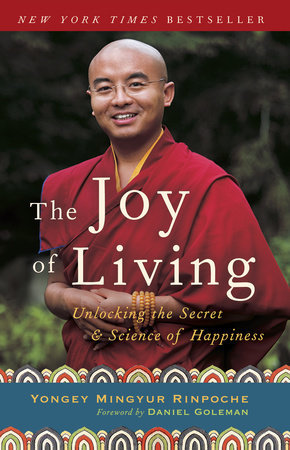
The Joy of Living is Yongey Mingyur Rinpoche's 2007 account of how Buddhist meditation works and why it produces measurable changes in the brain. Writing with Eric Swanson and with a foreword by Daniel Goleman, Mingyur draws on studies he participated in at the University of Wisconsin's Waisman Laboratory for Brain Imaging and Behavior, where EEG and fMRI recordings of his meditation showed unusually high gamma-wave activity associated with attention, perception, and compassion. The book is organised in three parts: the nature of mind from a Tibetan Buddhist perspective, practical meditation instruction accessible to beginners, and the long-term fruits of practice as seen through both the scientific literature and the author's personal experience.
Mingyur was born in Nepal in 1975 and suffered severe anxiety as a child; the book is partly an account of how meditation resolved that suffering, and he describes the Tibetan understanding of mind in terms that do not require prior Buddhist background. Daniel Goleman situates the book within the wider literature on contemplative neuroscience in his foreword.
Reception
A New York Times bestseller that debuted on the list in its first week, The Joy of Living has been translated into more than twenty languages. Critical response acknowledged the accessibility of Mingyur's explanations and the novelty of presenting Tibetan Buddhist teaching alongside first-person laboratory data. Reviewers in Buddhist and science publications noted that the science is introduced at a general level and that subsequent research has complicated several early findings about meditation and the brain. The book established Mingyur Rinpoche's international profile and has continued to sell steadily, particularly in the science-of-meditation and mindfulness markets.
Frequently asked
What is The Joy of Living about?
It is Yongey Mingyur Rinpoche's account of how Buddhist meditation works and why it changes the brain. The book combines Tibetan Buddhist teaching on the nature of mind with accounts of neuroscience studies — including brain-imaging sessions in which Mingyur participated — and practical meditation instruction accessible to beginners.
What did neuroscientists find when they studied Yongey Mingyur Rinpoche meditating?
Researchers at the University of Wisconsin's Waisman Laboratory for Brain Imaging and Behavior recorded EEG and fMRI data during Mingyur's meditation sessions and found unusually high gamma-wave activity in areas of the brain associated with attention, perception, and compassion. These findings are described in the book and in scientific papers from the same period.
Do I need a background in Buddhism or meditation to read The Joy of Living?
No. The book is written for readers with no prior experience. Mingyur introduces Tibetan Buddhist concepts in plain language and provides step-by-step meditation instruction in the second part of the book.