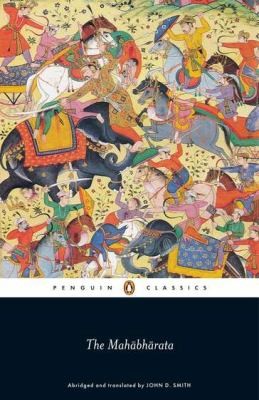
The Mahabharata is one of the two great Sanskrit epics of ancient India, the other being the Ramayana, and is traditionally attributed to the sage Vyasa. At roughly 100,000 verses it is among the longest poems ever composed. Its central story is a dynastic conflict between two sets of cousins, the five Pandava brothers and the hundred Kauravas, over the throne of Hastinapura. The quarrel passes through a rigged game of dice, a thirteen-year exile, and failed attempts at peace, and ends in an eighteen-day war on the field of Kurukshetra in which almost everyone is killed. Around this narrative the text gathers a vast body of myth, genealogy, law, and philosophy, including the Bhagavad Gita, which appears as a dialogue between Arjuna and Krishna on the eve of the battle. Scholars date the core of the text to roughly the fourth century BCE and its final form to about the fourth century CE; the exact dating is uncertain, and the poem grew over many centuries of oral and written transmission.
This entry refers to the Penguin Classics one-volume edition, abridged and translated by John D. Smith. Because a complete English translation runs to many thousands of pages, Smith translates in full the passages he judges most important to the narrative and its style — about a ninth of the whole — and links them with prose summaries of the rest, so the complete story can be followed in a single volume. It includes an introduction, notes, and a guide to the large cast of characters. Readers who want the unabridged text in English usually turn to the public-domain nineteenth-century translation of Kisari Mohan Ganguli or to the multi-volume modern translations by Bibek Debroy and, for the part that was completed, J. A. B. van Buitenen.
Contents
1 — Adi Parva (The Book of the Beginning)
2 — Sabha Parva (The Book of the Assembly Hall)
3 — Vana Parva (The Book of the Forest)
4 — Virata Parva (The Book of Virata)
5 — Udyoga Parva (The Book of the Effort)
6 — Bhishma Parva (The Book of Bhishma)
7 — Drona Parva (The Book of Drona)
8 — Karna Parva (The Book of Karna)
9 — Shalya Parva (The Book of Shalya)
10 — Sauptika Parva (The Book of the Sleeping Warriors)
11 — Stri Parva (The Book of the Women)
12 — Shanti Parva (The Book of Peace)
13 — Anushasana Parva (The Book of the Instructions)
14 — Ashvamedhika Parva (The Book of the Horse Sacrifice)
15 — Ashramavasika Parva (The Book of the Hermitage)
16 — Mausala Parva (The Book of the Clubs)
17 — Mahaprasthanika Parva (The Book of the Great Journey)
18 — Svargarohana Parva (The Book of the Ascent to Heaven)
Reception
The Mahabharata is one of the foundational texts of Hindu civilization and, with the Ramayana, one of the two Sanskrit epics (itihasa) that have shaped the literature, religion, and moral imagination of South and Southeast Asia for two millennia. It is read at once as scripture, as a treatise on dharma, and as a work of world literature, and its episodes are continually retold on stage, on screen, and in regional languages. The text is also a long-standing subject of debate: its treatment of caste and of women, the morality of the war and of Krishna's counsel, and the relation between its narrative and its didactic sections have been argued over by commentators for centuries and by modern scholars and readers today. Smith's Penguin abridgement is widely used as an accessible single-volume entry point and is praised for its readability and clear apparatus; reviewers note that the trade-off is the loss of much of the poem's texture and many of its episodes, and some readers prefer a complete translation for that reason.
Frequently asked
What is the Mahabharata about?
It is an ancient Sanskrit epic that tells of a dynastic war between two sets of cousins, the five Pandava brothers and the hundred Kauravas, for the throne of Hastinapura. The conflict moves through a rigged dice game, a long exile, and failed peace talks to an eighteen-day battle at Kurukshetra. Around this story the text collects a large body of myth, history, law, and philosophy, including the Bhagavad Gita.
Which edition is this, and how does it compare?
This is the Penguin Classics one-volume edition, abridged and translated by John D. Smith. He translates the most important passages in full — about a ninth of the text — and connects them with prose summaries so the whole story fits in a single book. Readers who want the complete text in English often use the public-domain Ganguli translation or the multi-volume versions by Bibek Debroy and J. A. B. van Buitenen.
Who wrote the Mahabharata?
It is traditionally attributed to the sage Vyasa, who also appears as a character within the story and is regarded as the compiler of the Vedas. Most scholars treat the authorship as traditional rather than historical: the poem took shape over many centuries of oral and written transmission, with its core dated to around the fourth century BCE and its final form to about the fourth century CE.