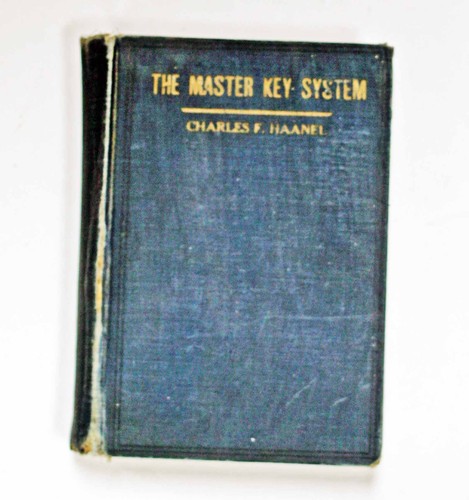
Charles F. Haanel's 1912 New Thought correspondence course, originally sold as 24 weekly lessons and published in book form in 1917. Each part pairs a short exposition of mental causation, concentration and visualisation with a practical exercise of progressively increasing duration, beginning with sitting still and ending with sustained held images. The work-text is structured as a year-long programme rather than a single read, with questionnaire and glossary supporting the lesson-by-lesson architecture.
The ideas draw primarily from New Thought philosophy, with additional influences from Hinduism, Freemasonry, Rosicrucianism, and the Bible. Haanel's central thesis is that thought is a creative force: the outer world is a reflection of the inner, and the disciplined, concentrated mind can attract and materialise desired conditions. Napoleon Hill credited Haanel in a 1919 letter with influencing Think and Grow Rich. Alongside Wattles's The Science of Getting Rich, The Master Key System is a documented direct source for Rhonda Byrne's The Secret (2006).
Nature compels us all to move through life. We could not remain stationary however much we wished. Every right-thinking person wants not merely to move through life like a sound-producing, perambulating plant, but to develop—to improve—and to continue the development mentally to the close of physical life.
Introduction
First lines
Nature compels us all to move through life. We could not remain stationary however much we wished. Every right-thinking person wants not merely to move through life like a sound-producing, perambulating plant, but to develop—to improve—and to continue the development mentally to the close of physical life.
Contents
Part One
Part Two
Part Three
Part Four
Part Five
Part Six
Part Seven
Part Eight
Part Nine
Part Ten
Part Eleven
Part Twelve
Part Thirteen
Part Fourteen
Part Fifteen
Part Sixteen
Part Seventeen
Part Eighteen
Part Nineteen
Part Twenty
Part Twenty-One
Part Twenty-Two
Part Twenty-Three
Part Twenty-Four
Reception
One of the foundational texts of the prosperity branch of New Thought and, alongside Wattles's Science of Getting Rich, a documented direct source for Rhonda Byrne's The Secret. An apocryphal but persistent claim has Bill Gates reading it at Harvard; the more verifiable line of influence runs through Napoleon Hill, Earl Nightingale and the 20th-century mail-order self-help industry. The book was reportedly suppressed by the Christian Science church in 1933 over doctrinal overlap, though primary documentation for that claim is thin. Modern reception is bifurcated: a small but devoted readership treats it as a complete system; mainstream psychology of religion treats it as a representative period document of the mind-cure movement.
Frequently asked
What is The Master Key System?
A 24-part New Thought correspondence course by Charles F. Haanel, originally sold as weekly lessons in 1912 and published in book form in 1917. Each part pairs a short theoretical exposition of mental causation and concentration with a daily meditation exercise, building progressively from sitting still to sustained visualisation.
How is The Master Key System connected to The Secret?
Alongside Wallace D. Wattles's The Science of Getting Rich, The Master Key System is one of the documented direct sources for Rhonda Byrne's 2006 book and film The Secret. Napoleon Hill also credited Haanel in a 1919 letter with influencing Think and Grow Rich.
Is The Master Key System in the public domain?
Yes. Both the 1912 correspondence course and the 1917 book edition pre-date the US copyright cutoff and are in the public domain, making the full text freely available through the Internet Archive and other repositories.