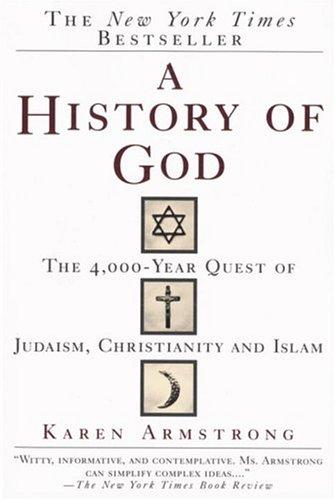
A History of God traces how the concept of God evolved over 4,000 years across the three major monotheistic traditions. Karen Armstrong follows the idea of God from the earliest Israelite tribes through the development of Judaism, Christianity, and Islam, and then examines how each tradition engaged with philosophy, mysticism, and the challenges of modernity. The book moves from ancient Canaan to the twentieth century, covering the God of the prophets, the God of the Nicene councils, the God of the Sufi mystics, the God of the Reformers, and the God challenged by Enlightenment reason and by Darwin, Nietzsche, and Freud. Armstrong closes by asking whether the concept of God can survive in a secular age.
The book is a work of comparative religious history rather than theology or apologetics. Armstrong treats the evolution of the idea of God as a human phenomenon — shaped by social, political, and intellectual conditions — while remaining attentive to the genuine spiritual experiences that the traditions preserve. Her argument is that ideas of God succeed when they speak to the conditions of their time and fail when they cease to do so, and that the rigid literalism associated with modern fundamentalism is itself a late innovation rather than a recovery of ancient faith.
First lines
IN THE BEGINNING, human beings created a God who was the First Cause of all things and Ruler of heaven and earth.
Contents
In the Beginning
One God
A Light to the Gentiles
Trinity: The Christian God
Unity: The God of Islam
The God of the Philosophers
The God of the Mystics
A God for Reformers
Enlightenment
The Death of God?
Does God Have a Future?
Reception
A History of God was a New York Times bestseller and sold over 700,000 copies in its original hardcover and paperback editions; it has since been translated into dozens of languages and is one of the best-known surveys of comparative religious history written for a general audience. Reviews in the mainstream press were broadly positive: The Washington Post Book World called it "an admirable and impressive work of synthesis," and The Sunday Times described it as "brilliantly lucid" and "splendidly readable." Academic reception was more mixed. Historians of religion appreciated Armstrong's command of primary sources and her ability to synthesise an unusually wide range of material accessibly; critics noted compression and simplification at points — particularly in her treatment of medieval Jewish and Islamic philosophy — and some found her framing of all religion as experiential rather than propositional questionable. The book has remained continuously in print and is widely assigned in undergraduate religious-studies courses.
Frequently asked
What is A History of God about?
Armstrong tracks the evolution of the concept of God across 4,000 years of Jewish, Christian, and Islamic history. The book moves from ancient Israelite religion through the development of monotheism, the rise of Christianity and Islam, medieval philosophy and mysticism, the Reformation, the Enlightenment, and the modern challenges to belief posed by science and secular thought.
Does Armstrong argue for or against the existence of God?
The book is a historical study, not a defence or refutation. Armstrong's argument is that the concept of God has changed repeatedly over time and that the rigid, literalist version of belief criticised by modern atheists is a relatively recent development. She traces the mystical and apophatic traditions as the deeper current running through all three religions.
How does the book treat Judaism, Christianity, and Islam?
Armstrong covers each tradition in parallel chapters — examining their formative texts, philosophical encounters with Greek thought, mystical developments, and modern crises. The book's comparative structure shows how each tradition addressed the same fundamental questions about the divine from different starting points and at different historical moments.