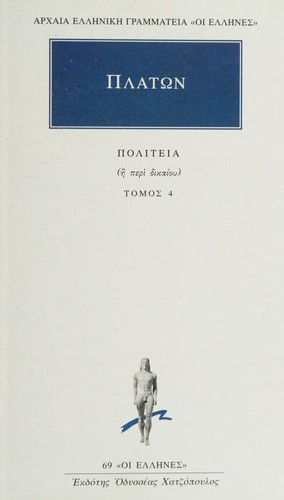
Plato's longest dialogue and the central document of his political philosophy, written in the early 4th century BCE. Across ten books Socrates and his interlocutors construct an ideal city in speech in order to define justice — first as a property of the polis, then by analogy as a property of the soul. The work develops the theory of the Forms, the tripartite soul (reason, spirit, appetite), the allegory of the cave, the philosopher-king, and a sustained critique of poetry and democracy.
The argument moves from the initial question — what is justice? — through a political vision to its metaphysical ground: the Form of the Good, which the philosopher must know before he is fit to govern. The work closes with the Myth of Er, a near-death account of the soul's journey. Nearly twenty-four centuries of continuous reading have made The Republic the foundational text of Western political philosophy and one of the most contested: Aristotle's Politics is partly a response; the Neoplatonists treated it as scripture; Popper's The Open Society and Its Enemies (1945) accused it of furnishing the blueprint for totalitarianism; Strauss and his students read it as ironic and pedagogical.
Until philosophers are kings, or the kings and princes of this world have the spirit and power of philosophy, and political greatness and wisdom meet in one, cities will never have rest from their evils.
p. 473d · Book V
First lines
I went down yesterday to the Piraeus with Glaucon the son of Ariston, that I might offer up my prayers to the goddess; and also because I wanted to see in what manner they would celebrate the festival, which was a new thing.
Contents
Book I — On Justice
Book II — On the Origin of the State
Book III — On Education and the Guardians
Book IV — On the Virtues of the City and Soul
Book V — On Women, the Family, and the Philosopher
Book VI — On the Form of the Good
Book VII — The Allegory of the Cave
Book VIII — On Imperfect Societies
Book IX — On the Tyrannical Soul
Book X — On Poetry and the Myth of Er
Reception
One of the foundational texts of Western philosophy, continuously read for nearly twenty-four centuries and the source of nearly every later debate on political theory, education, and the relation of reason to power. Aristotle's Politics is partly a response; the Neoplatonists treated it as scripture; the Renaissance recovered it through Ficino's Latin translation; modern political philosophy from Rousseau through Rawls has wrestled with its arguments. Twentieth-century reception split sharply: Karl Popper's The Open Society and Its Enemies (1945) accused the Republic of furnishing the blueprint for totalitarianism, while Leo Strauss and his students read it as ironic and pedagogical. The dialogue's standing in the canon is not in question; what it teaches remains open.
Frequently asked
What is The Republic about?
It is Plato's systematic attempt to define justice — first as a property of an ideal city, then by analogy as a property of the soul. The ten books move from the question "what is justice?" through the theory of the Forms, the allegory of the cave, and the philosopher-king, to a critique of poetry and democracy.
What is the Allegory of the Cave?
In Book VII, Socrates describes prisoners chained in a cave who mistake shadows on a wall for reality. The allegory illustrates the philosopher's journey from ignorance to knowledge of the Forms — and his obligation to return and govern despite preferring the light outside.
Why is The Republic controversial?
Karl Popper's 1945 The Open Society and Its Enemies accused the Republic of providing the blueprint for totalitarianism, citing its philosopher-king, censorship of poetry, and rigid class structure. Leo Strauss and others read the work as ironic and pedagogical rather than prescriptive. The debate continues.