What is Deepak Chopra?
Deepak Chopra is an Indian-American physician and author (b. 1946) who popularized Vedānta, Āyurveda, and mind-body medicine for Western audiences. He has published more than ninety books, with *Quantum Healing* and *The Seven Spiritual Laws of Success* among the best known. He is a translator-figure: the contemplative material he draws on is not original to him, and his standing inside academic non-dual circles is contested.
From cardiology to *Quantum Healing*
Chopra was born in New Delhi in 1946. He trained in medicine at the All India Institute of Medical Sciences and emigrated to the United States in 1970 for an internship in New Jersey and a residency in internal medicine. He became board-certified in endocrinology and was chief of staff at New England Memorial Hospital outside Boston by the early 1980s. In 1985 he visited Maharishi Mahesh Yogi at his Massachusetts ashram, began transcendental meditation, and was appointed founding director of the American Association of Ayurvedic Medicine. His first popular book, Return of the Rishi, appeared in 1988. *Quantum Healing* followed in 1989 and *Ageless Body, Timeless Mind* in 1993. The Chopra Center in Carlsbad, California, opened in 1996 and the Chopra Foundation in 2009.
How Chopra differs from Tolle, Spira, and Dyer
Readers new to Chopra often encounter him alongside Eckhart Tolle, Rupert Spira, and Wayne Dyer. The differences are significant. Tolle's teaching is tradition-neutral, centred on presence and the now, and makes no scientific claims. Chopra works explicitly from Āyurveda and Vedānta and invokes quantum mechanics. Spira teaches strict Advaita Vedānta from the Francis Lucille lineage without the wellness-business apparatus and without quantum vocabulary. Dyer was a self-help writer who moved toward spirituality late in his career; his framework is less doctrinally grounded than Chopra's.
What he teaches
Chopra's synthesis draws from three sources. The first is classical Indian Āyurveda, the medical system of the Atharva Veda tradition, where his training gives him grounded standing. The second is Advaita Vedānta, transmitted through his early association with Maharishi Mahesh Yogi and his later reading of the Upaniṣads and the Yoga Vāsiṣṭha. This places him inside the non-dual lineage that runs from Ramana Maharshi through contemporary teachers like Rupert Spira and Adyashanti. The third source is a popular-science register drawn loosely from twentieth-century quantum mechanics, which the working physics community has largely declined to endorse. Across forty years of writing, the core teaching has stayed consistent: consciousness is fundamental rather than emergent, the body is a process inside consciousness rather than its source, and ordinary suffering tracks the contraction of the apparent self.
Where to encounter him in the index
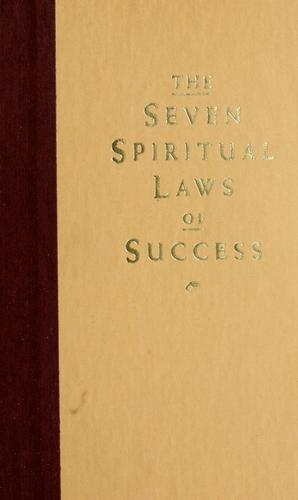
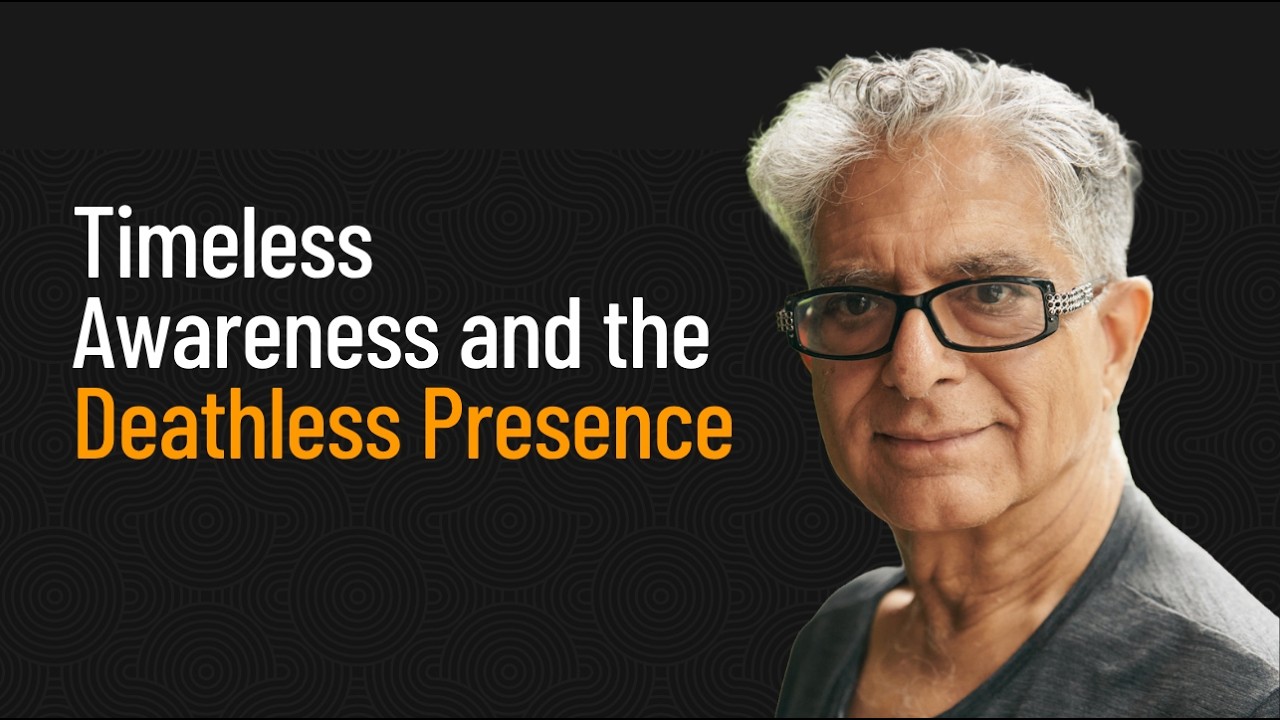
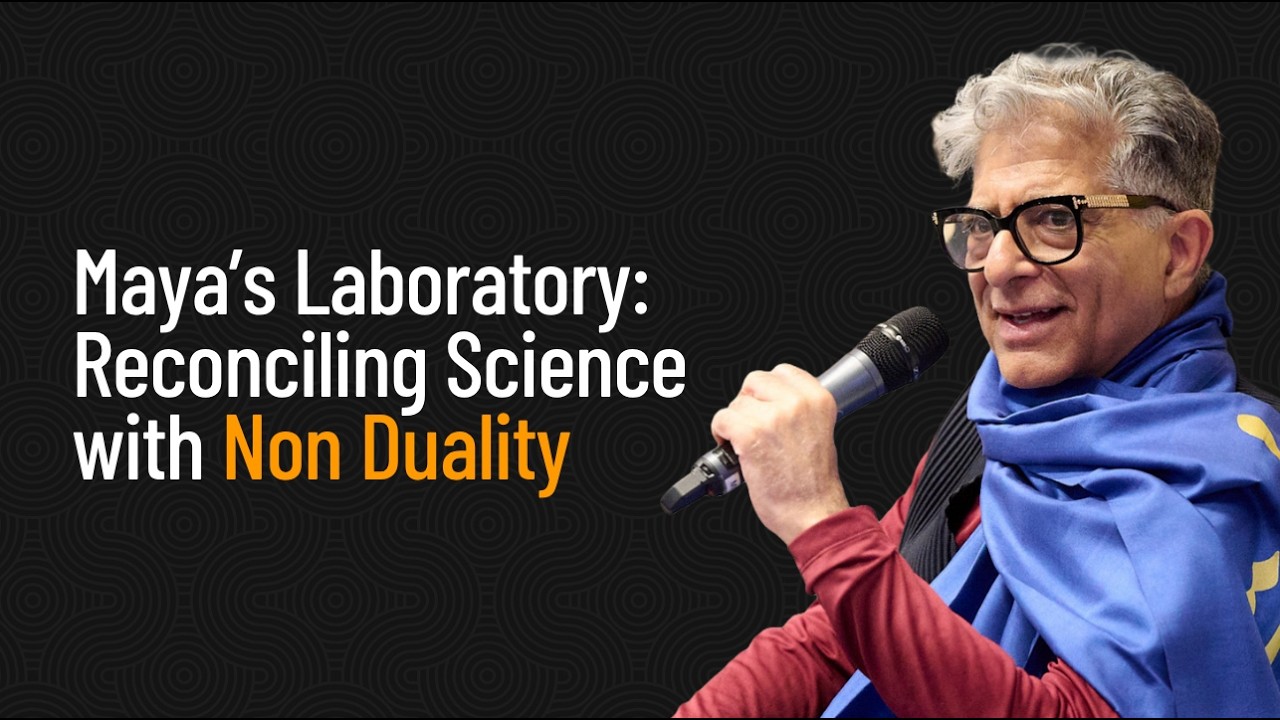
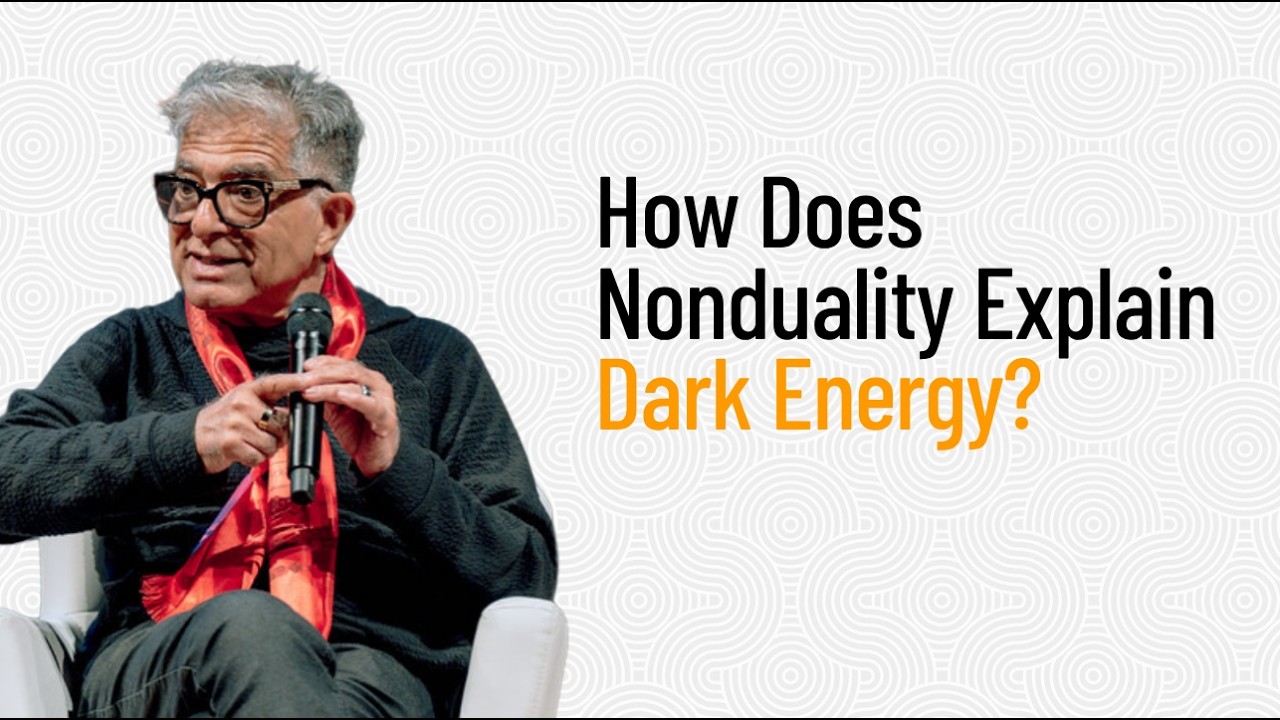
The index focuses on Chopra's late-career talks in which he works the non-dual material directly. What Is Consciousness? and The Untarnished Self — A Meditation Beyond Every Story are the clearest short introductions to his current register. Receiving Thoughts from the Matrix of Mind and Heart-Brain Connection — Yoga, Breath, and the Inner Field of Awareness are the meditation-meets-physiology talks that show how the Āyurvedic and Vedāntic threads sit together. Five talks from 2024 cover the direct path topics he has gravitated to in the past decade: Diamond Inquiry into Non-Conceptual Reality, Timeless Awareness and the Deathless Presence, Maya's Laboratory: Reconciling Science with Non-Duality, Dealing with Your Ego Identity, and How Non-Duality Reframes the Big Bang and Dark Energy. Heavenly Realms, Angels, and Encounters with Departed Loved Ones is the outlier, sitting closer to popular afterlife writing than to the Vedānta mainline. The foundational trade books in the index are *Quantum Healing*, *Ageless Body, Timeless Mind*, and *How to Know God*, alongside *The Seven Spiritual Laws of Success*, the gateway book most readers encountered first.
What the reception has been
Chopra's standing inside academic non-dual circles is contested in a way Rupert Spira or Adyashanti are not. Two complaints are most often raised. The first is the quantum register: professional physicists from Murray Gell-Mann onward have treated it as misappropriation rather than a serious extension of the mathematics. The second is the wellness-business apparatus around the Chopra Center, which mixes contemplative pedagogy with paid retreats and product lines in a way the more austere teachers in the same lineage do not. The defence Chopra himself most often makes is that he writes for the American medical patient or general reader, not the academic Vedānta scholar. His entry-level synthesis has functioned as a doorway through which many readers reached the more rigorous teachers downstream. That defence is harder to sustain for the quantum claims specifically, which the popular-physics community has had less patience with over the decades.