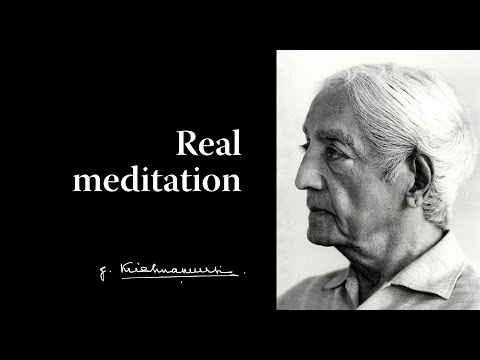
What is Jiddu Krishnamurti?
Jiddu Krishnamurti (1895–1986) was an Indian spiritual teacher raised by the Theosophical Society as the vehicle for a coming World Teacher. In 1929 he dissolved the organisation built around that prediction and declared truth is a pathless land. He spent the next fifty-seven years giving public talks on consciousness, choiceless awareness, and the structure of the observing mind. He refused throughout to act as a guru or to sanction any authority between a person and direct seeing.
Krishnamurti vs related teachers and traditions
Krishnamurti is not a non-dual teacher in the Advaita Vedānta sense, though his pointing at the dissolution of the observer-observed split converges with that lineage's mahāvākyas. He is not a Buddhist, though the long correspondence between his foundation and Buddhist teachers suggests considerable mutual recognition. He is not a guru, by his own insistent objection, though his sustained association with individual students including Mary Lutyens, David Bohm, and Pupul Jayakar produced something functionally close. The distinction he kept returning to was between the recognition of what is and the spiritual marketplace built up around the recognition. His refusal to enter that marketplace is the most consistent feature of the work.
The dissolution of the Order
Born in Madanapalle, southern India in 1895. The Theosophical Society, under Annie Besant and C. W. Leadbeater, identified him at thirteen as the vehicle for a coming World Teacher. They spent a decade preparing him: schools in Adyar and at Brockwood Park in England, and an organisation called the Order of the Star in the East built around the prediction, with several thousand devoted members awaiting his arrival. In August 1929, at thirty-four, he dissolved the Order on stage at Ommen, the Netherlands, in front of three thousand of its members. I maintain that truth is a pathless land, he told them. You cannot approach it by any path whatsoever, by any religion, by any sect. He returned the property the Order had collected on his behalf. He then spent the next fifty-seven years giving public talks while refusing every formal organisation that tried to reorganise around him.
Choiceless awareness
The instruction that recurs across the published dialogues and the talks at Brockwood Park and Saanen: notice what is happening, including the noticing itself, without the move to evaluate, name, or correct. He called this choiceless awareness. The observer, the one who would choose, is itself part of what is observed. Recognising this dissolves the apparent separation between them. The recognition is not a state to be reached. It is the seeing already going on once the search for a separate seer stops.
The published catalogue is large. The First and Last Freedom, Freedom from the Known, Education and the Significance of Life, Commentaries on Living, and The Awakening of Intelligence are the main written works. Recorded talks span thousands of hours. This discontinuity with ordinary spiritual transmission is part of the point: he had no lineage to pass on, and treated questions about his own authority as the very obstacle his listeners had come to him to solve.
Two conversational corpora stand apart within the wider catalogue. The dialogues with the physicist David Bohm, recorded across the 1970s and early 1980s and published as The Ending of Time and The Limits of Thought, bring his themes into contact with the foundational problems of physics. Bohm's reading gives the recordings a level of philosophical traction his public talks rarely had. The conversations with the Indian writer Pupul Jayakar, his student of fifty years, are the closest thing to autobiography on record. He resisted both formats throughout his life and accepted them only late, and selectively.
In the index
The First and Last Freedom is the most-cited single book. Aldous Huxley's foreword places it within the Western mystical tradition, while the text itself remains characteristically resistant to such placement. Freedom from the Known is the shorter, denser companion, edited from his talks of the late 1960s. Three video items represent the spoken voice: Real Meditation — Krishnamurti at Brockwood Park, 1980, How Is the Mind to Be Made Quiet?, and What Meditation Is Not — Krishnamurti with Oliver Hunkin, the last from BBC television and unusually accessible for a recording of his.