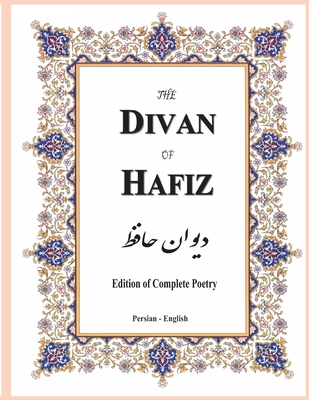
The Divan of Hafiz is the collected poetry of Shams-ud-Din Muhammad Hafiz (c. 1315–1390), the Persian lyric poet of Shiraz. It was compiled after his death and gathers his ghazals together with smaller numbers of other forms, including qasidas, masnavis, quatrains and fragments. The generally accepted text holds fewer than 500 ghazals; the exact count differs between the major scholarly editions. For centuries it has been one of the most widely copied and most loved books in the Persian-speaking world, kept in many homes and learned by heart.
This edition sets the original Persian beside the word-by-word English translation made by Henry Wilberforce Clarke (1840–1905), first published in 1891. Hafiz writes in the imagery of wine, the tavern, the beloved and the nightingale. Readers and scholars have long differed over how literally to take that imagery: some read it as Sufi devotional poetry in which earthly love stands for the love of God, some as worldly love poetry, and many as holding both senses at once. The poems are also used for bibliomancy, opening the book at random for guidance, a practice known as fāl-e Hāfez.
Reception
The Divan is regarded as a high point of Persian literature, and Hafiz as among the most quoted poets in the language; his lines are still used as proverbs and his tomb in Shiraz is a place of pilgrimage. The work reached Europe through the first printed edition (Calcutta, 1791) and a long series of translations and adaptations. Goethe's West-östlicher Divan (1819) was a direct response to it, and Emerson and others drew on it in English. English translations vary widely in method, from the free verse of Gertrude Bell and Richard Le Gallienne to Clarke's literal word-by-word approach, and no single English version is treated as definitive, partly because the ghazal's compression, wordplay and ambiguity resist translation. Scholarship continues to debate the text itself, since the surviving manuscripts disagree on which poems are authentic and on their order.
Frequently asked
What is the Divan of Hafiz?
It is the collected poems of Hafiz, the 14th-century Persian poet of Shiraz, compiled after his death. It is built around the ghazal — a short lyric form — and the generally accepted text holds fewer than 500 of them, alongside smaller numbers of other forms. For centuries it has been one of the most read and most memorised books in the Persian-speaking world.
Are Hafiz’s poems about earthly love or divine love?
Readers have long disagreed. The poems use the imagery of wine, the tavern and the beloved. Some read this as Sufi devotional poetry in which the beloved is God; some read it as worldly love poetry; and many hold that Hafiz meant both at once. The Divan does not settle the question, and that openness is part of why it has stayed available to so many readings.
What is fāl-e Hāfez?
It is a tradition of bibliomancy in which a reader asks a question, then opens the Divan at random and takes the poem on that page as guidance. It is still widely practised in Iran, especially at Nowruz and on Yalda night, and is one reason the book is found in so many homes.