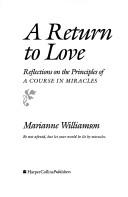
Marianne Williamson’s commentary on A Course in Miracles, drawn from her years lecturing on the Course in Los Angeles in the 1980s. The book is structured in two halves — Principles (Hell, God, You, Surrender, Miracles) and Practice (Relationships, Work, Body, Heaven) — and works as her clearest single statement of the Course’s logic: separation from God as the original problem, forgiveness as the practice that undoes it, love as the only reality. It is pitched at readers who would never approach the original 1,200-page Course directly, and it absorbs the Course’s vocabulary (miracle, atonement, Holy Spirit) into the everyday categories of relationship and work.
It is the title that turned Williamson into a household name. The February 1992 Oprah Winfrey appearance, in which Winfrey said she had bought a thousand copies to give away, sent A Return to Love to #1 on the New York Times list, where it spent 39 weeks. The “Our deepest fear is not that we are inadequate, our deepest fear is that we are powerful beyond measure” passage — frequently misattributed to Nelson Mandela — is from the “Work” chapter. Inside the Course community, Williamson is treated as its most successful popular interpreter, with some teachers finding her presentation insufficiently attentive to the metaphysics.
Our deepest fear is not that we are inadequate. Our deepest fear is that we are powerful beyond measure. It is our light, not our darkness, that most frightens us.
p. 190 · Chapter 7, “Work”
First lines
When we were born, we were programmed perfectly. We had a natural tendency to focus on love. Our imaginations were creative and flourishing, and we knew how to use them. We were connected to a world much richer than the one we connect to now, a world full of enchantment and a sense of the miraculous.
Contents
Hell
God
You
Surrender
Miracles
Relationships
Work
Body
Heaven
Reception
Williamson’s career-defining book — the February 1992 Oprah Winfrey appearance sent the title to #1 on the New York Times list, where it spent 39 weeks, and to more than 3 million copies sold. The “Our deepest fear is not that we are inadequate” passage, frequently misattributed to Nelson Mandela’s 1994 inaugural address, is in fact from the “Work” chapter of this book. Inside the Course community, Williamson is treated as the most successful popular interpreter; some Course teachers (notably Kenneth Wapnick) found her presentation insufficiently attentive to the underlying metaphysics. Her 2020 Democratic presidential run and earlier political shifts have complicated but not displaced her standing as the Course’s best-known public voice.
Frequently asked
What is A Return to Love about?
It is Marianne Williamson’s commentary on A Course in Miracles, structured in two halves — Principles and Practice — that walk a reader through the Course’s central logic (separation as the original problem, forgiveness as the practice that undoes it) and apply it to relationships, work, body, and faith.
Did Marianne Williamson write A Course in Miracles?
No. The Course was scribed between 1965 and 1972 by Helen Schucman, a research psychologist at Columbia University. Williamson is the Course’s best-known popular interpreter; A Return to Love is her commentary on its principles, drawn from years of lecturing on the material in Los Angeles in the 1980s.
Is the “Our deepest fear” passage by Nelson Mandela?
No — it is from the “Work” chapter of A Return to Love. The misattribution to Mandela’s 1994 inaugural address is widespread but unfounded; Williamson herself is the author, and the passage is built on Course in Miracles ideas about light, fear, and our reluctance to claim our own capacity.