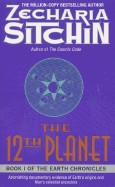
The 12th Planet is the first volume of Zecharia Sitchin's Earth Chronicles series. Published in 1976, it advances an interpretation of Sumerian and Akkadian cuneiform texts that diverges sharply from academic consensus. Sitchin, who taught himself cuneiform while working as an editor and journalist in New York, argues that Sumerian tablets describe a twelfth body in our solar system — a planet on an elongated, 3,600-year elliptical orbit he calls Nibiru. He identifies the Anunnaki, the Sumerian high gods, not as mythological figures but as a biological extraterrestrial civilisation that arrived on Earth hundreds of thousands of years ago.
Sitchin's further claim is that Homo sapiens were created by Anunnaki genetic engineering — a mixing of their genetic material with that of early hominids — to serve as a labor force in gold-mining operations. He draws on the Enuma Elish, the Epic of Gilgamesh, and Mesopotamian cylinder seals, which he interprets as astronomical maps. Academic Sumerologists, Assyriologists, and archaeologists have consistently rejected his translations and interpretations, characterizing his method as selective reading of ancient texts combined with unsupported hypothesis. The 12th Planet nonetheless sold millions of copies worldwide and is the foundational text of the modern ancient-astronaut genre.
Contents
Prologue
Chapter 1 — The Endless Beginning
Chapter 2 — The Sudden Civilization
Chapter 3 — Gods of Heaven and Earth
Chapter 4 — Sumer: Land of the Gods
Chapter 5 — The Nefilim: People of the Fiery Rockets
Chapter 6 — The Twelfth Planet
Chapter 7 — The Epic of Creation
Chapter 8 — Kingship of Heaven
Chapter 9 — Landing on Planet Earth
Chapter 10 — Cities of the Gods
Chapter 11 — Mutiny of the Anunnaki
Chapter 12 — The Creation of Man
Chapter 13 — The End of All Flesh
Chapter 14 — When the Gods Fled from Earth
Chapter 15 — Kingship on Earth
Reception
Bestseller; widely cited as the foundational text of the modern Anunnaki and ancient-astronaut canon. Sitchin's ideas have been roundly rejected by academic Sumerologists, Assyriologists, and archaeologists, who describe his translations as inaccurate and his methodology as selective. The book has been translated into more than 25 languages.
Frequently asked
What is The 12th Planet about?
It is the first of Zecharia Sitchin's Earth Chronicles. Sitchin re-reads Sumerian cuneiform texts as literal accounts of extraterrestrial visitors — the Anunnaki — who arrived from a planet he calls Nibiru on a 3,600-year orbit. He argues they created Homo sapiens through genetic engineering to serve as a labor force.
Who are the Anunnaki according to Sitchin?
In Sitchin's reading, the Anunnaki are the Sumerian high gods — figures such as Enlil, Enki, and Anu — reinterpreted not as mythological beings but as biological extraterrestrials. He argues they mined gold on Earth and created humans by mixing their genetic material with that of early hominids.
What do mainstream scholars say about Sitchin's theories?
Academic Sumerologists, Assyriologists, and archaeologists have consistently rejected Sitchin's interpretations. Critics note that his Sumerian translations are inaccurate, that Nibiru does not correspond to any known or hypothesized body, and that his method involves selecting evidence that fits a predetermined conclusion while ignoring contradictory material.