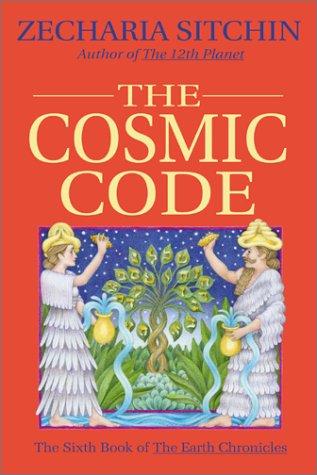
The Cosmic Code is the sixth volume of Zecharia Sitchin's Earth Chronicles series, published in 1998. It opens with a structure of concentric stone circles on Israel's Golan Heights, which Sitchin argues requires the same astronomical knowledge he attributed to the builders of Stonehenge in the previous volume. From there, the book covers a wide range of topics: the origins of the zodiac in Anunnaki religious practice, the role of fate and destiny in Sumerian cosmology, divine generational succession among the Anunnaki, and the claim that the Anunnaki withheld immortality from humanity during the genetic engineering of Homo sapiens. The title's "cosmic code" refers to Sitchin's argument that the Anunnaki encoded secret knowledge — about DNA, astrology, and the fate of mankind — in numerology and the Hebrew alphabet, and that figures such as Enoch were appointed custodians of this archive.
The book's second half shifts to history, tracing Marduk's rise to supremacy among the Anunnaki through events Sitchin reads in the Hebrew Bible, Babylonian texts, and the career of Abraham. Reviewers within the ancient-astronaut genre found the book more diffuse than earlier Earth Chronicles volumes, and several noted significant overlap with preceding entries. Scholars of Sumerology, archaeology, and genetics do not accept the interpretive framework.
Contents
Chapter 1 — Star Stones
Chapter 2 — Fate Has Twelve Stations
Chapter 3 — Divine Generations
Chapter 4 — Between Fate and Destiny
Chapter 5 — Of Death and Resurrection
Chapter 6 — The Cosmic Connection: DNA
Chapter 7 — Secret Knowledge, Sacred Texts
Chapter 9 — Prophecy: Writings from the Past
Chapter 10 — Navel of the Earth
Chapter 11 — A Time of Prophecy
Chapter 12 — The God Who Returned from Heaven
Epilogue
Reception
The sixth volume of the Earth Chronicles. Readers within the ancient-astronaut genre regard it as the series' most thematically scattered entry, covering astronomical observation, genetic encoding, and prophetic numerology without fully integrating them. Multiple reviews note that a substantial portion of the text reprises arguments from Books I through V before introducing the numerological and DNA threads. Sitchin's reading of the Hebrew alphabet's numerical values as an Anunnaki-designed code, and his association of Enoch with the custodianship of secret knowledge, generated the most discussion. His interpretation of the Golan Heights stone circles as an astronomical observatory built by the Anunnaki was dismissed by archaeologists. The claim that the Anunnaki did not give humanity immortality — evidenced, in his argument, by the absence of the relevant DNA strand — was rejected by geneticists. Scholars of Sumer, the Hebrew Bible, and ancient Near Eastern religion do not accept his interpretive framework.
Frequently asked
What is The Cosmic Code about?
It is Zecharia Sitchin's sixth Earth Chronicles volume, published in 1998. Opening with an ancient stone structure on Israel's Golan Heights, the book argues that the Anunnaki encoded secret knowledge — about DNA, astrology, and human destiny — in ancient numerology and the Hebrew alphabet. The second half traces Marduk's rise to dominance among the Anunnaki through Sitchin's reading of Babylonian and biblical texts.
What is the "cosmic code" Sitchin refers to?
In Sitchin's framework, the cosmic code is knowledge the Anunnaki transmitted to chosen human custodians such as Enoch. He argues this code is embedded in the numerical values of the Hebrew alphabet, in the structure of DNA, and in ancient Sumerian astronomical records — all pointing, in his reading, to humanity's genetic and celestial origins. Scholars of Sumerology and genetics do not accept this interpretation.
How does The Cosmic Code relate to the rest of the Earth Chronicles series?
It is the sixth of seven main volumes. It continues themes from When Time Began (Book V) — especially the Golan Heights site and astronomical interpretation — while extending into numerology, genetic encoding, and prophecy. Reviewers within the ancient-astronaut genre found it the most diffuse entry in the series, with significant material reprised from earlier volumes.