What is Choiceless awareness?
Choiceless awareness is Jiddu Krishnamurti's term for attention that includes the observer in what is observed, without any move to evaluate, name, or correct. It is not a technique but a description of what attention already is when the evaluating, choosing function has gone quiet.
Choiceless names the operative discipline. It is not the absence of preference but the suspension of the choosing function while attention is operating. Awareness names what remains when that suspension holds: a knowing that includes the contents of experience and the apparent knower in a single field. The phrase recurs across the published dialogues, the public talks at Brockwood Park and Saanen, and the long conversations with the physicist David Bohm. Krishnamurti resisted both the Sanskrit vocabulary of Advaita Vedānta, which would have named what he was pointing at sākṣin, the witness, and the Pāli vocabulary of Buddhism, which would have named it sati or the bare-attention element of satipaṭṭhāna. The instruction stands in those lineages while refusing to be placed inside any of them.
The structural move
Ordinary attention, on Krishnamurti's account, runs as a two-part operation. An observer attends to an observed object, with evaluation running between them: I like this, I don't, this is mine, this is other. That evaluating move generates the felt separation between the one who attends and what is attended to. It is also what keeps asserting the observer as a freestanding entity behind the experience. Choiceless awareness is what attention becomes when the choosing function goes quiet. The observer does not disappear through suppression, because suppression is itself a choice. What happens instead is that the apparent separation between observer and observed dissolves once the operation that maintained it has been recognised and set aside. What remains is the seeing that was always going on, once the search for a separate seer has stopped. Krishnamurti returned to this point hundreds of times in his recorded talks. He insisted the recognition was not a state to reach through technique but a noticing already available to whoever stopped looking for it elsewhere.
Where to encounter it in the index
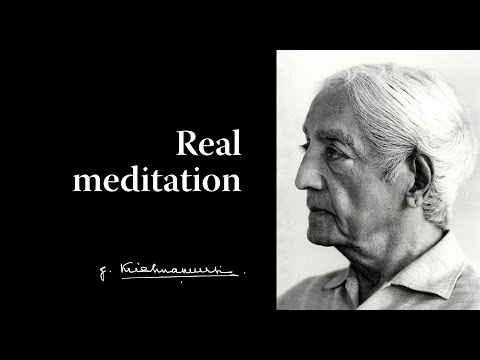
The First and Last Freedom is the most-cited book on the instruction. Aldous Huxley's foreword places it in the Western mystical tradition, while the text itself remains characteristically resistant to that placement. Freedom from the Known is a shorter, denser companion, edited from talks of the late 1960s. Three video items represent the spoken voice. Real Meditation — Krishnamurti at Brockwood Park, 1980 states the term and its structural argument at length. How Is the Mind to Be Made Quiet? takes the meditation-method question Krishnamurti was usually asked and turns it back on the asker. What Meditation Is Not — Krishnamurti with Oliver Hunkin is the BBC interview in which the refusal of method is laid out for a general audience. The recognition the instruction points at converges with adjacent teachings even where the vocabulary differs. Adyashanti's *Do Nothing* approaches the same collapse from the non-doing side: lay down every effort, including the effort of being a witness, and notice what remains. Rupert Spira's longer-form talk sets out the direct-path version of the same move in the advaita vocabulary Krishnamurti refused.
What it isn't
Choiceless awareness is not the absence of discrimination. Krishnamurti was a relentless discriminator in his cultural and political commentary. The recognition he pointed at does not erase the capacity to tell one thing from another. The choosing it suspends is the evaluative grasp at experience by an apparent observer, not the cognitive capacity to register difference. It is not mindfulness in the secular-clinical sense either. Clinical mindfulness retains the structure of a meditator observing experience. Krishnamurti's term is designed to dissolve precisely that structure. Nor is it a method to practise. Krishnamurti refused method itself as the principal obstacle to the recognition he was pointing at. The instruction describes what looking already is, once the search for a separate looker has stopped.