What is Clairvoyance?
Clairvoyance is the claimed ability to perceive events, objects, or information beyond the range of the ordinary senses. The word is French: clair (clear) and voyant (seeing). The concept appears across traditions that use different vocabularies for it. In the Yogic framework, it is a siddhi, a supernormal capacity, listed by Patañjali alongside telepathy, knowledge of past lives, and levitation as byproducts of sustained meditative concentration. In shamanic practice, it is the specialist's trained mode of vision in non-ordinary states. In the Theosophical tradition, it was the operative instrument through which Charles Leadbeater and Annie Besant claimed to investigate the [Akashic Records](lexicon:akashic-records) and map the architecture of the [subtle body](lexicon:subtle-body).
Clairvoyance vs adjacent concepts
Three concepts are commonly run together with clairvoyance. Telepathy is the claimed transmission of thoughts or feelings between minds without sensory contact. Precognition is the claimed foreknowledge of events that have not yet occurred. Mediumship is the claimed capacity to communicate with discarnate beings. Clairvoyance in its strict sense differs from all three: it is the perception of physically present but normally imperceptible realities, such as an object in a sealed box, a person's aura, or the Akashic impression of a past event. In practice the traditions often use clairvoyance as a generic term covering all four. The sharper distinctions belong to the parapsychological literature, which has attempted systematic experimental tests since the 1880s, more than to the contemplative traditions themselves.
The Yogic account
Patañjali's Yoga Sūtras devotes its third chapter to vibhūtis: the supernormal capacities that arise as side-effects of samyama, the focused application of concentration, meditation, and absorption to a single object. Dūradarśana (far-seeing) and dūraśravaṇa (far-hearing) are among the capacities catalogued there. Paramahansa Yogananda's *Autobiography of a Yogi* is the index's most extended narrative account of the siddhi tradition in practice. It records, at first and second hand, figures who exhibit preternatural sight, knowledge of distant events, and perception of inner states. The Yoga tradition is consistent across lineages on one point: the siddhis are not the goal. Patañjali names their pursuit as antara-vighna, an inner obstacle, in the same chapter that describes them. The practitioner who pauses to cultivate or display the capacity has turned aside from what the practice is meant to open.
The Theosophical contribution
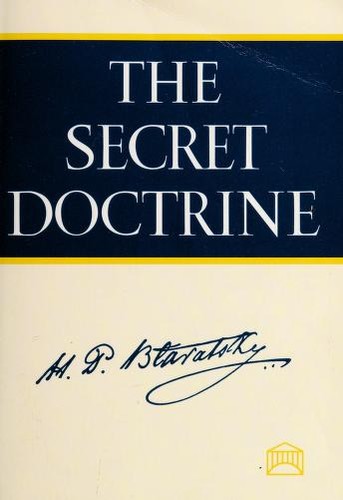
Helena Blavatsky's *The Secret Doctrine* (1888) grounds the Theosophical knowledge-claim in trained occult perception. The book presents its cosmological contents as the product of clairvoyant investigation, not historical scholarship. The Society's second-generation figures developed this into a working method. Charles Leadbeater, clairvoyant and prolific Theosophical writer, collaborated with Annie Besant on Occult Chemistry (1908), a claimed clairvoyant investigation of atomic structure, and on an extensive mapping of the subtle body, auras, and Akashic Records. Manly P. Hall's *The Secret Teachings of All Ages* surveys the concept across the Western esoteric traditions from Hermeticism through Kabbalah to Theosophy. William Walker Atkinson's *Advanced Course in Yogi Philosophy and Oriental Occultism* represents the early-twentieth-century channel through which Theosophical and Yogic frameworks for psychic faculty reached the American popular reader.
Where to encounter it in the index
The index's most direct engagement with clairvoyance as a working practice is Linda Howe's How to Read the Akashic Records. Howe presents access to the Akashic field through a specific prayer and receptive attention. The method is set within a broadly Theosophical cosmology but stripped of its doctrinal scaffolding, and is framed as a learnable attention skill rather than an exceptional psychic faculty. Yogananda's *Autobiography* is the primary document for the siddhi tradition in narrative form. Blavatsky's *Secret Doctrine* is the foundational Theosophical statement. Hall's encyclopaedia maps the concept's presence across the Western esoteric traditions in a single reference work.
What the traditions say it is not
The contemplative traditions treat clairvoyance as a capacity that arises from, and remains subordinate to, the central practice. The parapsychological tradition, originating in the Society for Psychical Research (London, 1882), attempts to isolate the capacity itself and subject it to controlled experimental test. The results of that research (Zener-card studies, remote viewing, Ganzfeld protocols) remain contested. The scientific consensus is that no repeatable, protocol-controlled demonstration has been produced. The contemplative traditions are largely indifferent to this finding. What they claim is not a discrete perceptual channel that can be cleanly isolated, but a change in the register of perception that arises from sustained inner work. That work, in their account, cannot be separated from the capacity it produces.