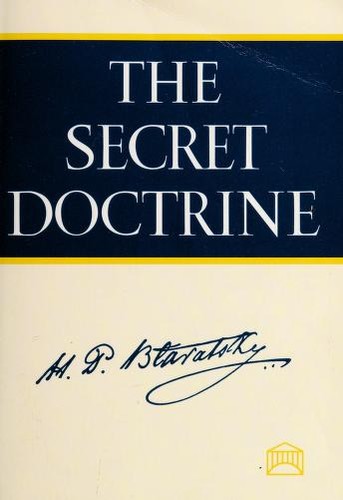
What is Helena Blavatsky?
Helena Blavatsky (1831–1891) was a Russian-born occultist and writer who co-founded the Theosophical Society in New York in 1875. Her 1888 book The Secret Doctrine assembled Hindu, Buddhist, Hermetic, and Kabbalistic material into a single esoteric cosmology. It was the first sustained Western synthesis of these traditions and became the prototype for modern spiritual literature in English.
Blavatsky compared to adjacent figures
Blavatsky is often grouped with the Victorian Spiritualists, but she was an explicit critic of Spiritualism. She held that séance phenomena involved astral shells, not genuine spirits of the dead, and that Spiritualism confused the psychic plane with the genuinely spiritual. Annie Besant, who led the Theosophical Society after Blavatsky's death, drew on the same vocabulary but took the institution in different directions: Besant promoted Jiddu Krishnamurti as a coming World Teacher and aligned the Society with the Liberal Catholic Church. Blavatsky's synthesis is also distinct from Hermeticism alone: Hermetic tradition is Western in origin, while Blavatsky's defining move was to fuse it with Sanskrit and Pāli sources from India.
Her life and work
Blavatsky was born Helena Petrovna Hahn into a minor aristocratic family in what is now Ukraine. She married briefly at seventeen and left. For the next eight years she travelled widely, speaking Russian, French, and English. She arrived in New York in 1873.
In 1874 she met Henry Steel Olcott, a Civil War colonel and journalist, at a Spiritualist farmhouse in Vermont. Together with William Quan Judge they co-founded the Theosophical Society in New York in 1875. Its two stated aims were forming a Universal Brotherhood of Humanity and investigating unexplained laws of nature.
Within two years Blavatsky had written Isis Unveiled (1877), a defence of the Ancient Wisdom against both Christianity and materialist science. The Society relocated to Adyar in Madras in 1879, making it the first significant Western esoteric organisation to centre itself in Asia.
Blavatsky reported correspondence with Masters Morya and Koot Hoomi, two Mahatmas she said were living in the Tibetan Himalayas. Much of the Mahatma Letters corpus was said to arrive through this channel. The Secret Doctrine, published in London in 1888, is the mature cosmological statement. Blavatsky presented it as a commentary on the Stanzas of Dzyan, a text she claimed to have seen at a Tibetan monastery. The Voice of the Silence (1889) followed as a devotional companion: seventy aphorisms for the aspirant on the Path.
Where to encounter her in the index
*The Secret Doctrine* runs to two volumes and nearly fifteen hundred pages, structured as Cosmogenesis and Anthropogenesis. It is the work most subsequent Western esoteric literature descends from. *The Voice of the Silence* is the short companion: three fragments of aphoristic instruction that have carried well across the century and are where most readers find their footing.
Alfred Percy Sinnett's *Esoteric Buddhism* (1883) is the early popular synthesis of the Mahatma-letter material that Blavatsky endorsed. Edwin Arnold's *The Light of Asia* (1879) is the verse life of the Buddha the Society promoted as devotional reading; it did more than any single book to introduce Indian Buddhism to a Victorian English audience.
Annie Besant's *Esoteric Christianity* represents the work of Blavatsky's successor, who carried the Theosophical vocabulary into Christian materials. Jiddu Krishnamurti's *At the Feet of the Master* was written under Theosophical Society auspices when Krishnamurti was a teenager in Besant's care. It is the document the institution produced just before its most prominent graduate dissolved its Order of the Star in 1929.
William Walker Atkinson's *Advanced Course in Yogi Philosophy and Oriental Occultism* is the American New Thought channel through which Theosophical material was repackaged for a different readership. Linda Howe's How to Read the Akashic Records is the contemporary inheritor of the Akashic Records vocabulary that Blavatsky, Leadbeater, and Besant introduced to English in the 1880s and 1890s. Manly P. Hall's *The Secret Teachings of All Ages* (1928) is the American esoteric encyclopaedia that consolidated the Theosophical synthesis for the next generation.
What is contested
Two long-running disputes define how she is received. The first is the Coulomb–Hodgson controversy of 1884–1885. Emma and Alexis Coulomb, former housekeepers at the Theosophical Society's Adyar headquarters, accused Blavatsky of fabricating the Mahatma phenomena: letters that fell from the ceiling, materialised tea-cups, apparent spiritual telegrams. They said she used hidden trapdoors and confederates. The Society for Psychical Research sent Richard Hodgson to Adyar; his 1885 report called Blavatsky one of the most accomplished, ingenious, and interesting impostors in history. The Society for Psychical Research retracted that report in 1986 on the grounds that Hodgson's methods were poor. By then, however, the 1885 verdict had already shaped a century of academic reception.
The second dispute concerns the Stanzas of Dzyan. No other witness has reported seeing the text; no manuscript has surfaced; scholars of Tibetan Buddhism have found no plausible original. The most straightforward reading is that Blavatsky composed the Stanzas herself and presented them as found. Sympathetic readers (John Algeo most carefully) argue the case is not closed. Unsympathetic scholars (Wouter Hanegraaff's Esotericism and the Academy is the standard reference) treat it as settled. Whether the Mahatmas were real Tibetan adepts, literary devices, or something else has never been resolved.
Why she matters here
The authenticity question and the influence question are separate. Regardless of how much of The Secret Doctrine Blavatsky composed herself, the synthesis Theosophy produced was genuinely new. It brought Sanskrit and Pāli vocabulary alongside Hermetic and Kabbalistic terminology, and presented karma and reincarnation to a Victorian readership as universal doctrine rather than as the property of any one religion.
Almost every twentieth-century esoteric or perennialist programme in English sits inside that vocabulary. The *Kybalion* of 1908, Manly P. Hall's Secret Teachings of All Ages, Edgar Cayce's Akashic Records readings, the New Age literature of the 1970s, and today's popular spirituality market all draw on terms and frameworks the Theosophical Society's books made standard.
The index treats Blavatsky as the originator of a tradition the perennial-philosophy literature, the modern contemplative register, and the popular esoteric market all descend from. Her specific claims should be read with the caution the Coulomb–Hodgson and Stanzas disputes together recommend.