What is Frithjof Schuon?
Frithjof Schuon (1907–1998) was a Swiss-German metaphysician and Sufi shaykh who became, after René Guénon, the central voice of the Traditionalist school. Traditionalism holds that every revealed religion preserves, in its esoteric core, the same metaphysical recognition, and that this transcendent unity is only accessible from inside one of the revealed forms.
How he differs from nearby thinkers
Schuon is most often grouped with Aldous Huxley under the label perennial philosophy, but their positions differ on a key point. Huxley treats the philosophia perennis as propositions that can be extracted from any tradition's mystical writers. Schuon insists that the metaphysical recognition is only accessible from inside the disciplines of one revealed religion, and that abandoning the exoteric form disqualifies the claim. His predecessor René Guénon took the opposite strictness in a different direction: Guénon concluded that only the Islamic esoteric tradition fully preserved the doctrine, effectively rejecting the cross-traditional plurality Schuon defended. The non-duality literature sometimes groups Schuon with Advaita teachers, but Schuon was a theist who grounded recognition in revealed religion, not in the Advaitic dissolution of the personal God.
His life and work
Frithjof Schuon was born in 1907 in Basel to a German violinist father and an Alsatian mother. He was raised partly in Mulhouse and lost his father at thirteen. In his early twenties, in Paris, he discovered the work of René Guénon. Guénon was the French metaphysician whose 1921 Introduction générale à l'étude des doctrines hindoues had given the Traditionalist school its founding texts. Schuon began corresponding with him in 1932. That same year he travelled to Mostaganem, in coastal Algeria, where the Sufi shaykh Aḥmad al-ʿAlawī initiated him into the Shādhilī–Darqāwī tariqa. He received the ijāza to teach within the order before al-ʿAlawī's death in 1934. The following four decades produced the books: De l'unité transcendante des religions (1948), Perspectives spirituelles et faits humains (1953), Logique et transcendance (1970), and more than twenty volumes in French. Less publicly, he led the Maryamiyya branch of the tariqa from the late 1930s. This branch is the principal Western channel through which his teaching is transmitted as a living spiritual lineage rather than a written corpus alone. He moved the centre of the order from Lausanne to Bloomington, Indiana in 1980 and remained there until his death in 1998.
Where to encounter him in the index
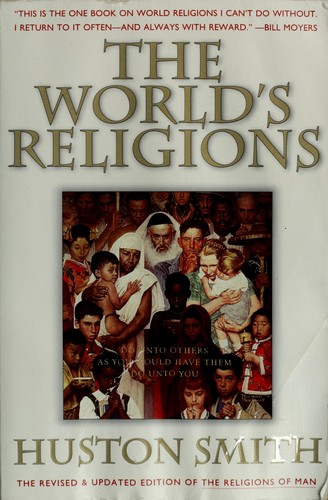
No book by Schuon himself is yet a row in the index. The reading he matters most for is best entered through adjacent works. Aldous Huxley's *The Perennial Philosophy* is the popular English statement of a thesis Schuon held in stricter form. Huxley treats the philosophia perennis as a set of recurring propositions extractable from any tradition's mystical writers. Schuon insists instead that the recognition is only accessible from inside the disciplines of a revealed religion, and that the exoteric form of each is non-negotiable for the practitioner. Huston Smith's *The World's Religions* is the warmer, pedagogical face of the same argument. Smith met Schuon in 1969, joined the Maryamiyya and remained a member for decades. The comparative-religion textbook that introduced two generations of American undergraduates to the transcendent unity idea is the unattributed Schuonian one. Idries Shah's *The Sufis* belongs to a different and partly opposed reading of Sufism: universalist, Anglo-popularising, and sceptical of strict tariqa affiliation. It is the foil against which the Schuonian alternative is best read. The Schuon corpus itself remains the necessary primary source for the lineage's positions and is a candidate for a future round of indexing.
What is contested
Two long-running disputes define the reception. The first concerns the legitimacy of the Maryamiyya. In the late 1980s Schuon introduced the primordial gatherings, in which initiates participated in a setting he read as a sacred dance of pre-Abrahamic provenance. Other Shādhilī–Darqāwī lines rejected this as a departure from the order's discipline. A 1991 Bloomington indictment against Schuon followed; it was dropped before trial. The primordial practices remain a defining division between Schuonian and non-Schuonian Sufi readers. The second dispute concerns the exclusivity of the metaphysic the books defend. Religious-studies critics, from Steven Katz's 1978 Language, Epistemology and Mysticism onward, read the perennialist claim as a constructivist artefact rather than a structural fact about contemplative experience. Schuon's defenders read Katz as collapsing into a relativism the constructivist programme was never able to defend in its own terms.
Why he matters here
Schuon is the figure on whom the strict version of the perennialist reading depends. The looser versions — Huxley's, the Theosophical, the ones the general English-language reader meets first — borrow the claim that traditions converge but drop the Schuonian condition that the practitioner must remain inside the exoteric discipline of one of them. Whether the looser versions retain anything of the original metaphysical thesis once that condition is dropped is the open question the Schuonian objection presses. It is also the question every later English-language presentation of mysticism-as-common-ground inherits, whether or not it acknowledges the source. The index reaches Schuon, for now, only through the figures and books that reach him second-hand. The corpus itself is the next round of work.