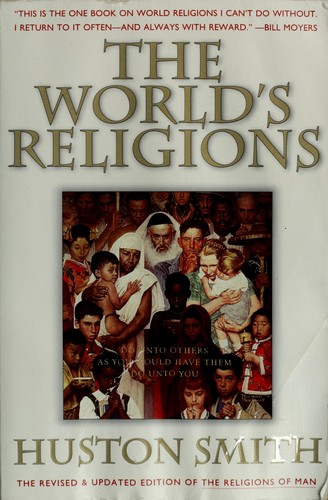
What is Huston Smith?
Huston Smith (1919–2016) was an American scholar of comparative religion, best known for *The World's Religions*, first published in 1958 as The Religions of Man. The book became the standard undergraduate textbook on world faiths for four decades and sold over three million copies. Smith was the leading mid-twentieth-century advocate of the perennialist reading: the view that the historic religions, beneath their distinct theologies, are reaching toward a single underlying recognition.
Smith, Huxley, and Campbell
Smith is often grouped with Aldous Huxley and Joseph Campbell as a mid-century figure who brought spiritual traditions to a wide American audience. They differ significantly. Huxley was a novelist and essayist whose *The Perennial Philosophy* assembled mystical passages from many traditions; Smith was a trained academic who gave Huxley's thesis a sustained textbook treatment, with the philological and ethnographic grounding Huxley lacked. Campbell's project was comparative mythology, tracing recurring narrative patterns across cultures, rather than the truth claims of the religious traditions themselves. Smith is not a contemplative teacher either: his work is descriptive and comparative, not instructional. Readers looking for a practice to take up will leave with a reading list and a comparative framework, not a method.
Biography in outline
Huston Cummings Smith was born in 1919 in Suzhou, China, to American Methodist missionary parents. He spent his first seventeen years in the trilingual mission-school world of treaty-port China. He returned to the United States for university and completed a PhD in philosophy at the University of Chicago in 1945. He then held teaching appointments at Washington University in St Louis (1947–58), MIT (1958–73), Syracuse (1973–83), and at the University of California at Berkeley as a visiting professor of religious studies. His working programme was consistent throughout: read the historic religions sympathetically from inside their own self-understanding, and translate that reading for non-specialist readers. The 1996 Bill Moyers PBS series The Wisdom of Faith with Huston Smith, a five-part conversation recorded when Smith was seventy-seven, was the most widely-watched extended interview with a comparative-religion scholar in American broadcast history.
The argument of his work
*The World's Religions* covers Hinduism, Buddhism, Confucianism, Taoism, Islam, Judaism, Christianity, and primal religion in separate chapters. Smith is careful to distinguish what each tradition specifically claims from what its neighbours claim. The synthesising move comes in a closing essay: beneath the visible differences, the traditions are reaching, in their respective vocabularies, for a recognition that is recognisably one. That is the perennial philosophy position, the reading Aldous Huxley's 1945 anthology had introduced to an English-language audience. Smith gave it a sustained textbook treatment with the scholarly equipment Huxley had lacked, at the very moment Steven Katz's 1978 constructivist critique was making the perennialist position academically contentious. His critics have also noted a romantic register in the primal religion chapter and a more philosophical than ritual treatment of Confucianism. Smith later engaged Huxley's *The Doors of Perception* and extended that reflection in his own Cleansing the Doors of Perception (2000), a sustained argument for the contemplative value of psychedelic experience. Lateral figures occupied overlapping but distinct corners of the same reading audience: Idries Shah's *The Sufis*, whose Sufism Smith reviewed sympathetically, and Manly P. Hall's *The Secret Teachings of All Ages*, the earlier American esoteric synthesis.
The constructivist critique
Smith's perennialist commitment is the part of his work the post-1978 religious-studies field has most consistently questioned. The challenge was stated most influentially in Steven Katz's Language, Epistemology, and Mysticism and extended by Bernard McGinn in Christian mysticism and Robert Sharf in Zen. Their argument: mystical experience is not a single cross-cultural recognition captured in different vocabularies. It is constituted by the doctrinal training of each tradition, so that the unio mystica of a Christian contemplative, the anattā recognition of a Theravāda meditator, and the fanāʾ of a Sufi murīd are distinct experiential states, not partial translations of one another. Smith's response, worked out most fully in Why Religion Matters (2001), is that the constructivists mistake the vocabulary of the report for the recognition the vocabulary is reaching for. The dispute remains unresolved. It is, on most current scholarly accounting, a load-bearing methodological choice any reader of the contemplative literature must make before engaging a particular tradition.