What is Helen Schucman?
Helen Schucman (1909–1981) was an American research psychologist at Columbia University and the scribe of *A Course in Miracles*. Between 1965 and 1972 she took down a 1,200-page text from an inner voice she identified as Jesus. Her colleague William Thetford transcribed the notes. The text was published in 1976 and became one of the most widely studied channelled works of the twentieth century. Schucman never identified publicly as a student of the material and requested that her role as scribe remain anonymous until after her death.
Helen Schucman vs Marianne Williamson and other channellers
Schucman is sometimes conflated with Marianne Williamson, who is the most visible public teacher of the Course. Williamson encountered the text in 1977, after it was published, and built a career interpreting and popularising it. Schucman produced the text. Williamson is a teacher within a lineage; Schucman is the lineage's source. The two had no known direct relationship.
Schucman is also grouped at times with other figures who claimed to receive spiritual transmissions, such as Helena Blavatsky or Edgar Cayce. What sets her apart is the institutional setting and the personal paradox. She was a credentialled academic psychologist at a major research university. She remained privately hostile to any interpretation of the experience as literally divine. No other major channelled text of the modern period was produced by someone who so consistently resisted the implications of the material she had scribed.
The scribing
Schucman had been a professor of medical psychology at Columbia since 1958 when the inner voice began in 1965. She was 56. She told Thetford about the experience, and he encouraged her to continue rather than dismiss it. The dictation ran over seven years. Schucman described the process as involving a kind of inner dictation she would then write in shorthand, not a voice she heard aloud. The material arrived as three volumes: a Text laying out the metaphysics, a Workbook for Students with 365 daily lessons, and a Manual for Teachers. She retired from Columbia in 1976, the same year the text was published by the Foundation for Inner Peace. Her identity as scribe was withheld from the general public at her request and disclosed only after her death in 1981.
Her ambivalence
Schucman's personal relationship to the Course was one of the unusual features of its reception. She was an atheist before the experience began and remained so in her self-description. She never taught the material, never led study groups, and did not publicly associate herself with the tradition she had produced. Those who knew her in her later years reported that she was unhappy and that the material's promise of inner peace had not translated into her own life. The gap between the text's teaching and her lived experience became a recurring observation among those who studied the Course. It has been read in several ways: as evidence that the transmission was genuinely impersonal, as a sign that she never worked the practice, and as a note of caution about the distance between scribing and living a teaching.
In the index
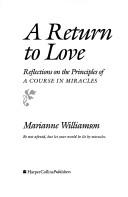
The *Course* itself is in the index as the source document. Its Workbook is what most students work through. Marianne Williamson's *A Return to Love* (1992) is the most widely read popular introduction to the Course's metaphysics and the text that brought Schucman's work to a mass readership. Schucman's biography sits at the intersection of several traditions covered here. The Course borrows from Christianity while departing from it in nearly every doctrinal sense. Its central claims belong to mysticism and to non-duality, the view that the perceived world is a projection of a separated mind. Schucman herself occupied none of these categories comfortably. She was a secular academic who produced one of the century's most consequential spiritual texts and then tried to step back from it.