What is Marianne Williamson?
Marianne Williamson (born 1952) is an American spiritual teacher and the best-known lay interpreter of A Course in Miracles, the channelled text first published in 1976 by the Foundation for Inner Peace. Her 1992 book *A Return to Love* reached the top of the New York Times bestseller list after Oprah Winfrey featured it, making Williamson the primary popular gateway to the Course in English.
Houston to the Course
Marianne Williamson was born in 1952 in Houston, Texas, into an assimilated American Jewish family. Her father was a Lithuanian-Jewish immigration lawyer. She dropped out of Pomona College after two years and worked through a sequence of cabaret-singing, nightclub, and bookstore jobs in New York and Los Angeles. She encountered A Course in Miracles in 1977, roughly eighteen months after the channelled text was first published in three volumes by the Foundation for Inner Peace. Her path followed the pattern common in the Course's early lay reception: initial resistance, gradual immersion in the Workbook lessons, and an eventual professional reorientation around the text. By 1983 she had relocated to Los Angeles and was lecturing on the Course weekly to small gatherings. By the late 1980s those gatherings had moved to the Philosophical Research Society in Los Feliz and were drawing several hundred people.
A Return to Love and the popular reception
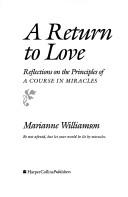
The break into wider visibility came in February 1992 with the publication of *A Return to Love: Reflections on the Principles of A Course in Miracles*. The book condenses the Course's 1,200-page metaphysics into thirteen short chapters. Its central proposition is that love is the underlying reality of which fear is the absence, and that forgiveness (in the Course's technical sense: the withdrawal of projection rather than a moral act of pardoning) is the mechanism by which love becomes available. Oprah Winfrey featured the book three months after publication and bought a thousand copies for friends. The title reached the top of the New York Times bestseller list within four months. The our deepest fear passage about playing small, often misattributed to Nelson Mandela's inaugural address, became one of the most-quoted self-help passages of the 1990s. The lecture *A Course in Miracles and the Power of Thought* is a representative example of how Williamson presents the material to a general audience.
AIDS-era community organising and the political turn
The decade in which A Return to Love built Williamson's audience was also the decade of her most consequential community work. The Los Angeles AIDS crisis of the mid-to-late 1980s coincided with her early lecturing years. Much of her early audience consisted of gay men with terminal diagnoses, for whom the Course's claim that the body is not who one is was an immediate practical concern rather than a metaphysical curiosity. Williamson founded Project Angel Food, a home-delivered meals service for people with HIV in Los Angeles, in 1989. She founded the Manhattan Center for Living, a non-residential support service for people with life-threatening illnesses, in 1991. Both remain operational. Her later political career pressed the same Course-derived framework into public life. She ran as an independent for the U.S. House from California's 33rd district in 2014, and entered the Democratic presidential primary in 2020 and again in 2024. *Marianne Williamson on Love and Action* is the clearest statement of the political direction: the Course's metaphysics, she argues, yield a politics of love in which structural injustice is the collective expression of the same projective error the individual has to work through.
Where she sits in the index
Williamson is the index's main entry-point into the A Course in Miracles lineage. *A Return to Love* and Powerful Beyond Measure are the most direct lay introductions to the Course's idealist metaphysics. The *Power of Thought* lecture and the *Love and Action* conversation extend the same framework into longer material. The lineage sits next to two other currents in the index. The Course's identification of the perceived world as a projection of mind places it near the non-dual tradition. Its popular reception in the American spiritual market puts it near the new-thought literature that Wayne Dyer and the law-of-attraction family carried into late-twentieth-century culture, though the Course works with a more rigorous metaphysical structure than that family typically supplies.
What she is and isn't
Williamson is sometimes placed in the New Age synthesis the American spirituality market produced in the 1980s. The label is inaccurate in two respects. The Course's operative metaphysics is closer to the Berkeleyan idealism of the eighteenth-century philosophical tradition than to the eclectic spiritual borrowings the New Age category covers. The forgiveness doctrine the Course teaches is also structurally distinct from the manifestation doctrine the law-of-attraction literature teaches, even when surface vocabulary overlaps. Williamson is also not the founder of the lineage she carries. The Course was complete and in circulation for over a decade before her first book appeared. Technical interpretation of the text is conducted by the Foundation for A Course in Miracles, Kenneth Wapnick's commentary corpus, and related academic study groups, where Williamson's popular framings are treated as gateway material rather than doctrinal core. Williamson herself has described her role in interviews as that of a lay teacher in a lineage whose architecture sits elsewhere.