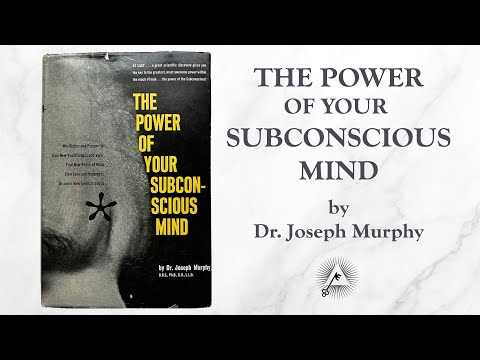
What is Joseph Murphy?
Joseph Murphy (1898–1981) was an Irish-American New Thought minister and prolific author. His 1963 book *The Power of Your Subconscious Mind* argued that the *subconscious mind* faithfully executes whatever beliefs are deliberately impressed on it by the conscious mind. The practitioner's task is to govern those inputs, especially in the drowsy state just before sleep. The book has sold tens of millions of copies and has remained in print for more than sixty years. It is the single text most responsible for the late-twentieth-century law-of-attraction literature's focus on subconscious programming.
Murphy vs. Neville Goddard and The Secret
Murphy is often grouped with Neville Goddard, whose teachings overlap structurally. Both treat the pre-sleep state as technically privileged, and both argue that an impressed inner state shapes outer events. The difference is tone. Murphy's frame is clinical and case-study driven, focused on practical outcomes like healing and financial improvement. Goddard's is mystical and rooted in biblical imagination. Murphy is also not the same as The Secret or the contemporary manifestation industry. Those later texts borrow his central image while typically dropping his insistence on discipline and continued action. He never taught that wishing replaces doing.
Background
Joseph Denis Murphy was born in 1898 in Ballydehob, County Cork, the son of a Catholic schoolmaster. He trained for the priesthood at the National University of Ireland and left the Catholic Church in his twenties after what he later described as a crisis of doctrine. He emigrated to the United States in the 1920s and spent some years as a pharmacist in New York. There he encountered the New Thought movement through Christian Science and Hermetic writings circulating in the city. He was ordained in the Church of Divine Science in 1946 and took the pulpit of the Divine Science Church of Los Angeles in 1949, holding it for the next twenty-eight years. His books carry the titles Doctor of Psychology and Doctor of Divinity; the first has been disputed by the credentialing institution, the second was granted by Divine Science itself. He died in 1981 in Laguna Hills, California. About thirty books, plus pamphlets and lecture transcripts, have remained in print ever since.
The thesis
Murphy's argument, distilled across his books, is that the *subconscious mind* faithfully executes any belief the conscious mind deliberately impresses on it. His signature instruction is suggestive auto-conditioning before sleep. In the drowsy state immediately before sleep, when the critical faculties are quiet, the practitioner repeats a short statement of the desired condition as already accomplished. Murphy argues this impresses the wished state on the subconscious for incubation through the night. His case studies recur across the books as a signature: the patient cured, the salesman whose territory expanded, the woman whose marriage repaired itself. Each is treated as ordinary evidence rather than miracle.
In the index
Joseph Murphy's *The Power of Your Subconscious Mind* is the central text, structured as twenty short chapters each pairing a principle with a sequence of case illustrations. The Master Key Society's recorded reading of the original 1963 edition is the cleanest contemporary audio of the text in its first form, before the posthumous editorial revisions that later editions absorbed. Murphy's reach extends through several contemporary descendants in the index. *How to Reprogram Your Mind and Become a Conscious Creator* restates the basic teaching for an audience arriving via short-form video. Hans Wilhelm's *Conscious, Subconscious and Spirit-Conscious Mind* is a gentle popularisation of Murphy's tripartite model. Wayne Dyer's *Programme Your Subconscious Before Sleep* applies Murphy's pre-sleep technique directly. Neville Goddard's *The Power of Awareness* is the parallel statement from the more mystical wing of the same New Thought current. The broader law-of-attraction literature later pulled the shared thesis in both directions.