What is The Mystery?
The Mystery is the name given across contemplative traditions to something they agree cannot be fully named: the irreducible ground or source of existence that defies every concept applied to it. In Christian mysticism it surfaces as the divine darkness, the deus absconditus, the hidden God beyond every attribute. In Hinduism it is nirguna Brahman, the Absolute without qualities. In Zen Buddhism it is the face before your parents were born. In Sufism it is al-Ghayb, the Unseen. Each name is a finger pointing at something that cannot be captured in language. The traditions do not all agree on what it is. They do agree that it cannot be fully said.
The Mystery vs mysticism, apophatic theology, and the Absolute
Mysticism is the tradition of practices aimed at encountering ultimate reality directly. The Mystery is what those practices point toward. It is not the discipline itself but the thing being approached. Apophatic theology is the method: it approaches the divine by saying what it is not, stripping away each predicate in turn. The Mystery is the terminus of that method. It is the irreducible remainder once everything that can be said has been stripped away. The Absolute is a philosophical term for the unconditioned ground of all existence. Where the Absolute is a metaphysical claim about the nature of reality, the Mystery preserves the epistemic point: this ground cannot be fully known, held, or represented.
How traditions name the unnameable
What is striking about the Mystery is how consistent its structure is across traditions, even when the names differ. Pseudo-Dionysius, a fifth-century Syrian theologian, described God as beyond being and beyond knowing, present in the darkness that lies past all speech. The 14th-century English text *The Cloud of Unknowing* taught that God can be touched only by love, not by thought. Thomas Merton's *Thoughts in Solitude*, written during his hermitage years, returns repeatedly to the silent ground that no discourse can enter. The Hindu tradition distinguishes saguna Brahman, Brahman with attributes approachable through devotion, from nirguna Brahman, which can only be pointed at and never depicted. Zen uses the koan not to answer questions but to exhaust the answering mind, until what remains cannot be named. In each case the tradition does not abandon language. It uses language until it hits the wall, and what lies on the other side of the wall is what this entry is about.
The structure of not-knowing
Every tradition that acknowledges the Mystery also teaches a form of learned ignorance. Nicholas of Cusa, the 15th-century Christian philosopher, called it docta ignorantia: the discovery that the deepest knowing is a kind of unknowing. This is not agnosticism. The practitioner is not concluding that nothing can be known. The discovery is that the thing being pointed at is larger than any framework brought to it. This is why Rupert Spira consistently redirects questions about the nature of awareness back to direct looking rather than description: the Mystery is not answered by a better theory, it is met by setting theory aside. Nisargadatta's *I Am That* uses the bare sense of existing, the felt 'I am', as the nearest possible pointer, precisely because it names without conceptualising. Adyashanti's *Do Nothing* takes the same orientation to stillness: not filling the space with thought, but staying in contact with the ground that thought cannot enter.
The Mystery in the index
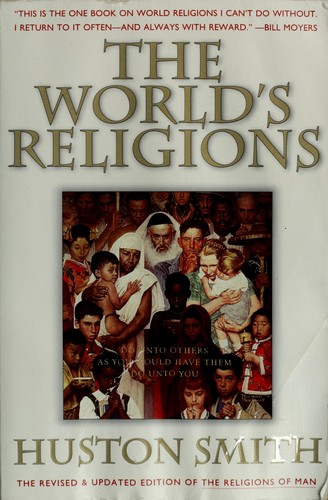
Huston Smith's *The World's Religions* provides the clearest comparative map, tracing how six world religions approach the unknowable ground and where the family resemblance between them lies. For the Christian contemplative tradition, Thomas Keating's *Open Mind, Open Heart* approaches the Mystery through Centering Prayer: the practitioner learns not to grasp at thoughts or experiences, but to open to what cannot be held. For the non-dual Vedantic stream, Rupert Spira's *Being Aware of Being Aware* investigates the nature of consciousness from the inside, holding the question open rather than collapsing it into an answer. Jonathan Pageau approaches the Mystery through the Orthodox Christian symbolic imagination: the icon that points beyond itself to what cannot be depicted, and the liturgy that rehearses approaching the infinite through finite forms.