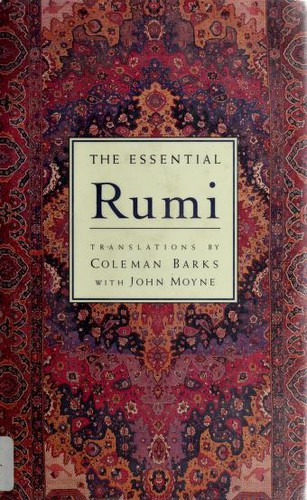
Coleman Barks's 1995 selection of Rumi translations — actually English versifications of John Moyne's literal scholarly translations rather than direct translations from the Persian, since Barks does not read Persian. The book covers Rumi's Mathnawi, Divan-e Shams-e Tabrizi and Rubaiyat in thematic groupings, and is the version through which most English-speaking readers encounter Rumi.
The book is organised into thirteen themed sections — opening with "The Tavern" and closing with "The Turn" — moving through bewilderment, emptiness, the desire-body, mystical union, the role of the sheikh, and the whirling that defines the Mevlevi order Rumi founded. Rumi (1207–1273) was born in Balkh (present-day Afghanistan), lived most of his adult life in Konya (Anatolia), and composed his major works in Persian; his friendship with the mystic Shams of Tabriz catalysed the poems that became the Divan-e Shams-e Tabrizi.
Out beyond ideas of wrongdoing and rightdoing, there is a field. I'll meet you there.
Masnavi, Book III — translated by Coleman Barks
Contents
The Tavern: Whoever Brought Me Here Will Have to Take Me Home
Bewilderment: I Have Five Things to Say
Emptiness and Silence: The Night Air
Spring Giddiness: Stand in the Wake of This Chattering and Grow Airy
Feeling Separation: Don't Come Near Me
Controlling the Desire-Body: How Did You Kill Your Rooster, Husam?
Sohbet: Meetings on the Riverbank
Being a Lover: The Sunrise Ruby
The Pickaxe: Getting to the Treasure Beneath the Foundation
Art as Flirtation with Surrender: Wanting New Silk Harp Strings
Union: Gnats Inside the Wind
The Sheikh: I Have Such a Teacher
The Turn: Dance in Your Blood
Reception
The single most important book in the modern English Rumi reception — Rumi has been the bestselling poet in the United States for three decades, and Barks's versions are responsible for that audience. Persian-literature scholars, including notably Fatemeh Keshavarz and Omid Safi, have argued that Barks's versions strip out the explicitly Islamic and Quranic content of Rumi's poetry, producing a deracinated "spiritual but not religious" Rumi that the historical Rumi would not recognise. Barks acknowledges this in his prefaces; the controversy is a productive one that has reshaped subsequent translations (Brad Gooch's biography, Alan Williams's literal Mathnawi). Sales-wise the Barks versions remain dominant.
Frequently asked
What is The Essential Rumi?
It is Coleman Barks's 1995 selection of Rumi's poetry rendered into English verse — the Mathnawi, Divan-e Shams-e Tabrizi, and Rubaiyat organised into thirteen thematic sections. Barks worked from John Moyne's literal scholarly translations of the Persian originals rather than from the Persian directly.
Did Coleman Barks translate from the Persian?
Barks does not read Persian. His versions are English versifications of literal translations produced by Persian scholar John Moyne. This has prompted sustained debate: scholars including Fatemeh Keshavarz and Omid Safi argue that Barks's adaptations remove the explicitly Islamic and Quranic dimensions of Rumi's work. Barks acknowledges the critique in his prefaces.
Why has Rumi become so popular in the English-speaking world?
Rumi has been the bestselling poet in the United States for roughly three decades, a phenomenon almost entirely attributable to Barks's accessible free-verse renderings. The Barks editions made Rumi legible to a post-1970s Western spiritual audience that was drawn to his themes of longing, union, and the dissolution of the separate self — themes the translations emphasise while softening the explicitly Islamic frame.