What is the Masnavi?
The Masnavī (Masnavī-yi maʿnavī, spiritual couplets) is a Persian poem of roughly 25,000 couplets by Jalāl al-Dīn Rūmī (1207–1273), dictated to his disciple Ḥusām al-Dīn Chalabī between about 1260 and Rūmī's death. It is built from Quranic exegesis, parables, folk tales, and address from master to disciple. The Sufi tradition has regarded it as the most influential single work in the Persian mystical canon, known by the honorific the Quran in Persian.
What the Masnavi is not
The Masnavī is not a systematic theology. It does not lay out doctrine in numbered propositions. It shows doctrine by enacting it, through parables and the address of the sheikh to his disciple, the murīd. Nor is it the pre-rational or purely ecstatic work that the Western reception of Rūmī sometimes implies. The text is dense with Quranic citation, classical Arabic logic, and the technical vocabulary of kalām and falsafa. Its moments of non-duality-adjacent insight are embedded in a long discursive structure that does not separate easily from its scholarly apparatus. It is also not a love poem in the modern English sense. The love the Masnavī describes is not romantic feeling but ʿishq, the Sufi term for the soul's structural orientation toward God. Human relationships in the poem are treated in the tradition as channels for that love, not as its ultimate object.
The composition
The Masnavī-yi maʿnavī was dictated to Rūmī's principal disciple Ḥusām al-Dīn Chalabī between roughly 1260 and the poet's death in 1273. The masnavī is a Persian prosodic form in which each couplet's two halves rhyme with each other, not with the lines around them. This frees the poet to sustain a single argument or narrative for thousands of verses, unconstrained by the closed strophes of the ghazal. Rūmī pushed the form to extreme length: roughly 25,000 couplets across six books. There is no fixed table of contents and no single arc. Parables interrupt one another; scriptural commentary breaks into the parables; sudden first-person addresses to the disciple or to God break into the commentary. The opening of book one, the song of the reed, is the most quoted opening in Persian letters. Its central metaphor is the human soul as a cut reed, made into a flute by the wound of separation from its origin, and returning through the song that wound enables.
The Quran in Persian
The honorific the Quran in Persian was given to the Masnavī in the fifteenth century by the Sufi poet ʿAbd al-Raḥmān Jāmī. The description is not an exaggeration. Almost every parable is staged as a commentary on a Quranic verse. Almost every doctrinal aside extends the taʾwīl, the inner interpretation, that the Sufi reading tradition had developed since the ninth century. The Masnavī also gives the doctrines classical Sufism had worked out in prose a parable-bearing, mnemonic form that let them travel beyond scholarly circles. *Fanāʾ*, annihilation in God, and baqāʾ, abiding in God, the unity of being inherited from Ibn ʿArabī, the wayfaring through stations and states: all are rendered in a shape accessible to the educated reader rather than only the trained jurist. After Rūmī, the Masnavī is what most ordinary educated Persian-, Turkish-, Urdu- and Pashto-speaking Sufis actually read.
The Mevlevi inheritance
Rūmī's son Sulṭān Walad organised the disciples into the order that became the Mevlevi, the whirling dervishes, centred on Konya in modern central Turkey. The order's liturgy is built around recitations of the Masnavī set to ney-flute and percussion. The rotational dance, the samāʿ, was developed as a way of reciting the text with the body. The Mevlevi survived the dissolution of the Ottoman Sufi orders in 1925: Atatürk closed every tekke by decree, but a narrow legal exception reclassified the order as a cultural performance. They have continued to teach the text through the twentieth century as both a liturgical and an interpretive curriculum.
In English
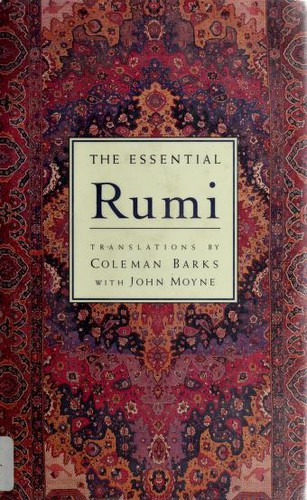
The standard scholarly English edition is Reynold Nicholson's eight-volume Cambridge translation (1925–1940), still the basis of most academic citation. A more readable contemporary option is Jawid Mojaddedi's Oxford World's Classics rendering, of which the first book is the place to begin. The version most English-language readers encounter, though, is not a translation of the Masnavī at all. Coleman Barks's *The Essential Rumi* is a selection drawn mostly from A. J. Arberry's literal cribs and rendered into free-verse American English. It is not Persian scholarship, and the academic field has been ambivalent about it for thirty years. It is also the reason Rūmī is the bestselling poet in the United States. What the field calls the Barks Rumi is a distinct artefact: closer to the Masnavī's spirit than to its lexicon, more lyrical than philosophical, and almost entirely stripped of the Quranic exegesis that anchors the original.
In the index
The Mojaddedi translation of book one is the recommended scholarly starting point. Coleman Barks's *The Essential Rumi* is the popular doorway and the one most readers will already know. For the surrounding Sufi context, Idries Shah's *The Sufis* is a controversial but durably influential introduction. Robert Graves's foreword made it canonical in the English counterculture. The academic field has criticised some of its claims, and the framing of Sufism as a non-sectarian wisdom tradition rather than an Islamic mystical movement is now read as politically loaded. It remains the most-read English-language introduction nonetheless. Henri Corbin's *Alone with the Alone* addresses the Ibn ʿArabī substrate the Masnavī draws on. Corbin's idea of creative imagination is the philosophical key to reading the parables as theophany rather than allegory. Hafiz's *The Gift*, in Daniel Ladinsky's renderings, is the next-generation Persian Sufi voice — a century after Rūmī, in lyric rather than narrative form, with the same doctrinal substrate.