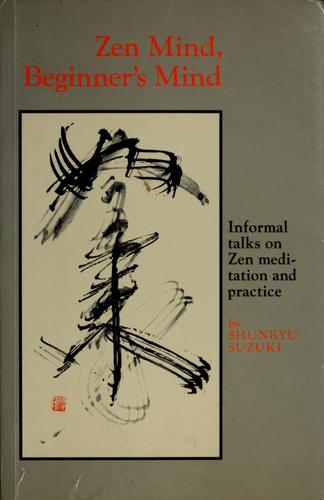
Edited transcripts of Shunryu Suzuki’s informal talks at Sokoji in San Francisco and at the Los Altos Zendo in the late 1960s, organised by his students Trudy Dixon and Marian Derby and introduced by his Dharma successor Richard Baker, with a preface by Huston Smith. The thirty-eight short chapters are arranged in three sections — Right Practice, Right Attitude and Right Understanding — and the Sōtō Zen attitude that gives the book its title sits at the front: that the mind of the beginner, open and not-knowing, is closer to awakening than the mind of the expert.
First published by Weatherhill in 1970, then carried forward by Shambhala from 2006, the book has remained the most-circulated Sōtō Zen text in English for half a century. It is short — about 138 pages — but the talks are deliberately repetitive and circular, returning to the same instructions on posture, breath, and intention from different angles. Suzuki died of cancer in December 1971, eighteen months after publication.
In the beginner’s mind there are many possibilities, but in the expert’s mind there are few.
Prologue, “Beginner’s Mind”
Contents
Prologue: Beginner’s Mind
Part 1 — Right Practice: Posture
Part 1 — Right Practice: Breathing
Part 1 — Right Practice: Control
Part 1 — Right Practice: Mind Waves
Part 1 — Right Practice: Mind Weeds
Part 1 — Right Practice: The Marrow of Zen
Part 1 — Right Practice: No Dualism
Part 1 — Right Practice: Bowing
Part 1 — Right Practice: Nothing Special
Part 2 — Right Attitude: Single-minded Way
Part 2 — Right Attitude: Repetition
Part 2 — Right Attitude: Zen and Excitement
Part 2 — Right Attitude: Right Effort
Part 2 — Right Attitude: No Trace
Part 2 — Right Attitude: God Giving
Part 2 — Right Attitude: Mistakes in Practice
Part 2 — Right Attitude: Limiting Your Activity
Part 2 — Right Attitude: Study Yourself
Part 2 — Right Attitude: To Polish a Tile
Part 2 — Right Attitude: Constancy
Part 2 — Right Attitude: Communication
Part 2 — Right Attitude: Negative and Positive
Part 2 — Right Attitude: Nirvana, the Waterfall
Part 3 — Right Understanding: Traditional Zen Spirit
Part 3 — Right Understanding: Transiency
Part 3 — Right Understanding: The Quality of Being
Part 3 — Right Understanding: Naturalness
Part 3 — Right Understanding: Emptiness
Part 3 — Right Understanding: Readiness, Mindfulness
Part 3 — Right Understanding: Believing in Nothing
Part 3 — Right Understanding: Attachment, Non-attachment
Part 3 — Right Understanding: Calmness
Part 3 — Right Understanding: Experience, Not Philosophy
Part 3 — Right Understanding: Original Buddhism
Part 3 — Right Understanding: Beyond Consciousness
Part 3 — Right Understanding: Buddha’s Enlightenment
Epilogue: Zen Mind
Reception
The most-circulated Sōtō Zen book in English and one of the founding texts of American Buddhism — required reading at most Zen centres in the lineage Suzuki founded (San Francisco Zen Center, Tassajara, Green Gulch). His student David Chadwick’s Crooked Cucumber adds the biographical layer the talks deliberately omit. Inside Japanese Sōtō the book is sometimes considered slightly too American; outside it, the simplicity is the point. The post-Suzuki succession crisis at SFZC and the Richard Baker controversies sit in the historical background but do not touch the book itself.
Frequently asked
What is Zen Mind, Beginner’s Mind about?
Edited transcripts of Shunryu Suzuki’s informal talks at Sokoji and the Los Altos Zendo in the late 1960s, organised by his students Trudy Dixon and Marian Derby. The thirty-eight short chapters are arranged in three parts — Right Practice, Right Attitude and Right Understanding — and circle around the Sōtō Zen attitude that gives the book its title: that the beginner’s open, not-knowing mind is closer to awakening than the expert’s.
Who edited the book?
Trudy Dixon and Marian Derby edited Suzuki’s talks into chapters; Richard Baker, Suzuki’s American Dharma successor, wrote the Introduction; Huston Smith contributed the Preface. The book was first published by Weatherhill in 1970, eighteen months before Suzuki’s death in December 1971.
Why does it remain influential?
It is the most-circulated Sōtō Zen book in English and one of the founding texts of American Buddhism — required reading at most Zen centres in the lineage Suzuki founded (San Francisco Zen Center, Tassajara, Green Gulch). Inside Japanese Sōtō it is sometimes considered slightly too American; outside it, the simplicity is the point.