What is Sōtō Zen?
Sōtō Zen (曹洞宗, Sōtō-shū) is the largest of the three traditional schools of Japanese Zen, with around 14,000 temples in Japan today. It descends from the Chinese Caodong lineage and was brought to Japan in 1227 by Dōgen (1200–1253). Its defining practice is shikantaza, just sitting: upright posture, natural breath, eyes half-open, no object of attention, no goal. Dōgen taught that this sitting is not a method for reaching awakening but its very activity.
Origin in Chinese Caodong
The Chinese parent school, Caodong (曹洞宗), was founded by Dongshan Liangjie (807–869) and his disciple Caoshan Benji (840–901). The school's name compresses one character from each of their place-names. Two texts set its meditative tone. Dongshan's Five Ranks analysed the relationship between the absolute and the relative. Hongzhi Zhengjue (1091–1157) then developed silent illumination (mòzhào): an open, alert, receptive awareness in which the divide between seeker and sought is allowed to dissolve. This is the orientation Dōgen would carry to Japan. The Linji school that became Japanese Rinzai grew alongside Caodong in Tang and Song China. The two methods coexisted in monastic practice from early on and the rivalry between them was never absolute.
Dōgen's transmission to Japan
Dōgen (1200–1253) trained at the Caodong monastery of Tiantong under Tiantong Rujing and received Dharma transmission before returning to Japan in 1227. He spent the rest of his life establishing the practice in Japan. His foundational texts are the Fukan-zazengi (Universally Recommended Instructions for Zazen, 1227), the Bendōwa (Talk on the Wholehearted Practice of the Way, 1231), and the ninety-five-fascicle Shōbōgenzō compiled over the following two decades. Each argues that seated practice is not a technique for producing awakening but its very activity. Eihei-ji, the monastery he founded in 1244 in present-day Fukui prefecture, remains one of the two head temples of the school. The second, Sōji-ji near Yokohama, was established by Keizan Jōkin (1264–1325) two generations later. Keizan's broader pastoral approach is widely credited with the school's expansion across rural Japan.
Practice
The central practice is shikantaza, just sitting. As described in the Fukan-zazengi: posture upright but not rigid, breath natural, eyes half-open, no object of attention, no intention to attain. This is what most separates Sōtō from Rinzai's kōan-led curriculum. Sōtō does use kōans. Dōgen wrote at length on cases in the Shōbōgenzō. But the kōan is treated as illumination of a practice already underway, not as the engine of breakthrough. The wider form includes daily liturgy, ōryōki formal meal practice, and kinhin walking meditation between sitting periods. The school's jukai lay-ordination ceremony, in which non-monastics receive the sixteen bodhisattva precepts, has been the main entry point for Western students.
In the index
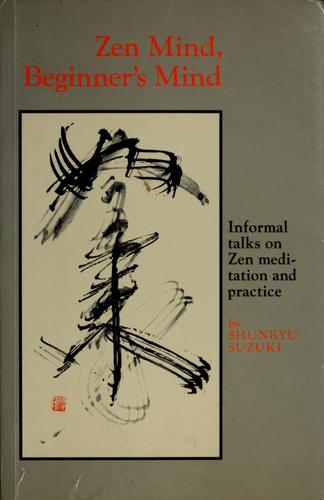
*Zen Mind, Beginner's Mind* is the canonical English-language entry into the Sōtō register. It collects talks Shunryū Suzuki gave to American students through the 1960s, edited by Marian Derby and Trudy Dixon, and has been in print continuously since 1970. The book treats shikantaza not as introductory practice but as the heart of the school, faithful to Dōgen's Fukan-zazengi. Adyashanti's *Do Nothing* descends from that lineage: fourteen years of Maezumi-lineage Sōtō-Rinzai training stand behind it, even where the Japanese vocabulary has been dropped. Alan Watts's *The Way of Zen* gives the historical background, tracing the line from Bodhidharma through Huineng to Dōgen's Eihei-ji. Thich Nhat Hanh on emptiness, signlessness and aimlessness approaches the same sensibility from the Vietnamese Thiền lineage, which descends from the same Chán root. The Plum Village teaching from Br. Troi Duc Niem extends that line into the next monastic generation.
Sōtō and adjacent traditions
Sōtō versus Rinzai: both are Zen schools rooted in Chinese Chán and both use zazen and kōan literature. Rinzai's training builds toward achieving kensho through concentrated kōan inquiry. Sōtō does not aim at a moment of breakthrough. The sitting is the point. Sōtō versus secular mindfulness: programs such as MBSR share Sōtō's non-striving quality but extract it from its monastic container. Sōtō practice is embedded in robes, liturgy, lineage transmission, formal meals, and a teacher relationship. Western Sōtō centres descended from the San Francisco Zen Center retain most of that form; secular programs do not. Sōtō versus anti-intellectualism: a common Western reading imagines Zen as hostile to doctrine. Dōgen's Shōbōgenzō is the most philosophically dense corpus any Zen school has produced. The instruction to drop conceptual elaboration during zazen is not a ban on careful reading off the cushion.