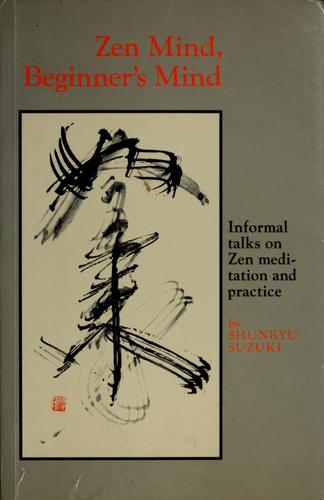
What is Shunryū Suzuki?
Shunryū Suzuki (1904–1971) was a Sōtō Zen priest from Japan who moved to San Francisco in 1959. He founded the San Francisco Zen Center in 1962 and Tassajara Zen Mountain Center in 1967, the first Sōtō training monastery outside Asia. His collection of talks, *Zen Mind, Beginner's Mind* (1970), has stayed continuously in print and is the most widely-read introduction to Sōtō Zen practice in English.
Shunryū Suzuki vs D.T. Suzuki and Rinzai Zen
He is not the same person as D.T. Suzuki, the scholar whose 1920s essays introduced Zen ideas to Western readers. D.T. Suzuki wrote about Zen; Shunryū Suzuki taught people to sit. His school is Sōtō, not Rinzai. That distinction matters: the Sōtō path is built around shikantaza, just sitting, not the koan curriculum that Rinzai schools use. He was also not a popular-philosophical writer in the mode of Alan Watts. Watts explained Zen ideas to Western readers; Suzuki gave his students a daily practice.
Background
Suzuki was born in 1904 in Kanagawa prefecture, the son of a Sōtō Zen priest. He was ordained at thirteen and trained at Eiheiji and Sōjiji, the two head temples of the Sōtō school that Dōgen founded in the thirteenth century. He inherited his father's temple, Rinsō-in, near Yaizu in 1936. He spent the war years there, privately opposed to Japan's militarist alignment, and cared for the temple and its parishioners through the decade that followed. In 1959, at fifty-five, he accepted a temporary posting to lead Sōkō-ji, the small Sōtō temple serving the Japanese-American community in San Francisco. He intended to stay three years. He stayed twelve, until his death.
San Francisco and Tassajara
The congregation at Sōkō-ji was elderly Japanese-American Buddhists. But in the early 1960s a different audience found him: the post-Beat San Francisco of Alan Watts, Gary Snyder, and Philip Whalen, a generation that had read about Zen and wanted to sit. Suzuki opened zazen sessions to anyone who turned up, every morning, without ceremony. The San Francisco Zen Center incorporated formally in 1962. In 1967, Suzuki and his students bought a remote hot-springs property in the Ventana Wilderness south of Big Sur and converted it into Tassajara Zen Mountain Center, the first Sōtō training monastery established outside Asia. Green Gulch Farm, the Zen Center's third site, opened in 1972, a few months after his death.
Zen Mind, Beginner's Mind
*Zen Mind, Beginner's Mind* (1970) is not a treatise. It is a sequence of brief talks given to American students through the 1960s, edited by Marian Derby and Trudy Dixon. Its opening sentence has become one of the most-quoted lines in English-language Buddhism: in the beginner's mind there are many possibilities, and in the expert's there are few. The book presents shikantaza as the central work of the Sōtō school, faithful to Dōgen's Fukan-zazengi and to the lineage Suzuki had inherited. The instruction is plain: posture, breath, presence with whatever arises, no adding. The book has stayed continuously in print since 1970.
Lineage
Suzuki named Richard Baker as his sole Dharma heir. Baker succeeded him as abbot at his death from cancer in December 1971. The succession crisis of the early 1980s, when Baker stepped down, is a complicated chapter that the institution has documented openly. The training programmes Suzuki built at SFZC, Tassajara, and Green Gulch produced Mel Weitsman, Reb Anderson, Norman Fischer, and Edward Brown, and a second generation of teachers who have carried the same plain-spoken Sōtō register into Zen centres across North America. Inside Japanese Sōtō, Suzuki was a country priest of modest standing; the talks he gave to a small American congregation have outlasted, by reach, anything he produced in Japanese.