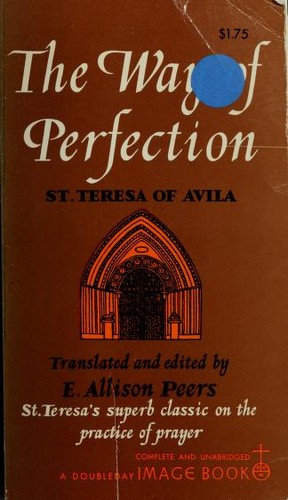
Teresa of Ávila's mid-1560s instructional treatise written for the discalced Carmelite nuns of her newly-founded convent of San José in Ávila — a practical manual on the contemplative life, organised around three virtues of love, detachment, and humility, and culminating in an extended meditation on the Lord's Prayer as a complete map of mental prayer. Less systematic than her later The Interior Castle, more directly pedagogical, written in deliberately plain Castilian Spanish for readers without formal theological training. The book exists in two autographs: the earlier, more intimate Escorial manuscript and the revised Valladolid manuscript, which became the definitive text and reduced the chapter count from 73 to 42.
The forty-two chapters of the Valladolid version fall into three movements: a preamble on the founding of the reformed Carmelite convent and the importance of poverty (Chapters 1–3); a treatment of the three essentials of the prayer-filled life — mutual love, detachment from creatures, and humility (Chapters 4–15); and a chapter-by-chapter commentary on the Paternoster, covering the Prayer of Recollection, the Prayer of Quiet, and union with God (Chapters 27–42). Together they make this the most accessible of Teresa's three major mystical works alongside her Life and The Interior Castle.
Mental prayer is, I think, nothing other than an intimate sharing between friends; it means taking time frequently to be alone with Him who we know loves us.
Chapter 28, on mental prayer
First lines
The sisters of this Convent of Saint Joseph, knowing that I had had leave from Father Presentado Fray Domingo Bañes, of the Order of the glorious Saint Dominic, who at present is my confessor, to write certain things about prayer, which it seems I may be able to succeed in doing since I have had to do with many holy and spiritual persons, have, out of their great love for me, so earnestly begged me to say something to them about this that I have resolved to obey them.
Contents
Prologue: Why this book was written
Chapter 1: The reason for founding the Convent in strict observance
Chapter 2: On poverty and how we should regard bodily needs
Chapter 3: On fraternal love and prayer; on helping those who defend the Church
Chapters 4–6: Mutual love among the sisters; on perfect love
Chapters 7–9: On detachment from creatures, kinsfolk, and the world
Chapters 10–12: On humility; on confessors and spiritual directors
Chapters 13–15: On mortification and the snares of self-love
Chapter 16: The importance of virtue for contemplation
Chapter 17: The Game of Chess: on how the soul gives check and mate to the King of love
Chapters 18–19: Not all souls are called to contemplation; consolation for active souls
Chapters 20–26: On mental prayer, vocal prayer, and the Prayer of Recollection
Chapters 27–29: The Prayer of Quiet and how to practise it
Chapters 30–42: The Lord's Prayer: a petition-by-petition map of mental prayer to union
Reception
One of the canonical works of the Spanish Golden Age of mysticism alongside John of the Cross, and a foundational text of post-Tridentine Catholic contemplative practice. Teresa was canonised in 1622, named a Doctor of the Church by Paul VI in 1970 (the first woman to receive the title), and her writings remain compulsory reading in Carmelite formation worldwide. The book's reception has been continuous across four centuries — read by Thérèse of Lisieux, Edith Stein, Thomas Merton — and has been increasingly studied outside its religious frame by historians of women's spirituality (Alison Weber, Carole Slade) for its rhetorical strategies under the watchful eye of the Spanish Inquisition.
Frequently asked
What is The Way of Perfection about?
It is a practical manual on the contemplative life, written by Teresa of Ávila around 1565–66 for the nuns of her reformed Carmelite convent in Ávila. The book has three movements: a preamble on poverty and the founding of the convent; a treatment of the three essentials of the prayer-filled life — mutual love, detachment, and humility; and an extended petition-by-petition commentary on the Lord's Prayer that covers the Prayer of Recollection, the Prayer of Quiet, and union with God.
How does The Way of Perfection differ from The Interior Castle?
The Interior Castle (1577) is the more systematic and theologically ambitious of the two, mapping the soul's journey through seven concentric mansions to divine union. The Way of Perfection is earlier, more practical, and deliberately plain in style — written for nuns without formal theological training. Teresa herself described it as a "living book" of direct instruction rather than speculative theology.
Why is Teresa of Ávila called a Doctor of the Church?
Pope Paul VI declared Teresa of Ávila a Doctor of the Church in 1970, making her the first woman to receive that title (alongside Catherine of Siena on the same day). The designation recognises her writings — above all The Interior Castle and The Way of Perfection — as authoritative guides to Christian contemplative theology and mystical practice.