What is Quantum Mysticism?
Quantum mysticism is a set of beliefs that draw on concepts from quantum physics to support spiritual or mystical worldviews. Observer effects, entanglement, and non-locality are the most commonly borrowed concepts. The term is used both by proponents, who see genuine parallels between physics and contemplative insight, and by critics, who regard such parallels as misreadings of the science.
Quantum Mysticism vs quantum physics
The confusion at the centre of quantum mysticism is a category mistake. In quantum mechanics, an observer is any physical measuring apparatus that interacts with a quantum system. It is not a conscious mind. When physicists say observation collapses the wave function, they mean measurement forces a quantum system into a definite state. They do not mean that consciousness determines reality. Similarly, entanglement describes a correlation between the measurement outcomes of two particles, such that knowing one instantly constrains what you can know about the other. This correlation cannot be used to send information faster than light, and it carries no implication that distant things are connected by mind or spirit. Quantum effects of this kind operate at subatomic scales and do not scale up to the macroscopic world of organisms, brains, or social experience.
How it emerged
Fritjof Capra's *Tao of Physics*, published in 1975, drew systematic parallels between twentieth-century physics and Hindu, Buddhist, and Taoist cosmologies. Capra argued that the holism and paradox of quantum mechanics echoed themes in Eastern metaphysics. The book found a large readership outside physics departments and established a template that later writers followed. The Fundamental Fysiks Group, an informal gathering of physicists at Lawrence Berkeley Laboratory in the mid-1970s, explored similar territory from inside the discipline, connecting quantum mechanics to parapsychology and consciousness research. By the late 1980s, the vocabulary had spread into medicine and popular spirituality. Deepak Chopra's *Quantum Healing*, published in 1989, claimed that quantum effects in the body could explain mind-body healing. The word quantum became a general-purpose intensifier in New Age writing, attached to everything from energy fields to emotional states.
Where the lines are drawn
Mainstream physicists have been consistently critical. The objection is not that the contemplative traditions are wrong but that quantum mechanics is being invoked incorrectly. Quantum coherence at biological temperatures degrades almost instantly; nothing in the neuroscience or cellular biology of human beings requires quantum-mechanical explanation of the kind quantum mysticism proposes. *Wholeness and the Implicate Order* by David Bohm, published in 1980, is the closest thing to a serious physicist's treatment of the territory. Bohm proposed a genuine alternative interpretation of quantum mechanics, the pilot-wave model, and developed a philosophical framework, the implicate order, that has real content in the philosophy of physics. Even so, Bohm drew a distinction between what the physics supports and what contemplative traditions claim. Earlier, Erwin Schrödinger's *What Is Life?* and *Mind and Matter* explored whether the unity described in Vedanta had any resonance with the picture of nature that physics was assembling. Schrödinger's engagement with the Upanishads was genuine and he said so explicitly, but he did not argue that quantum mechanics proved the Vedantic position. The line between genuine philosophical exploration by physicists and the misappropriation of physics vocabulary is the central contested boundary in this field.
In the index
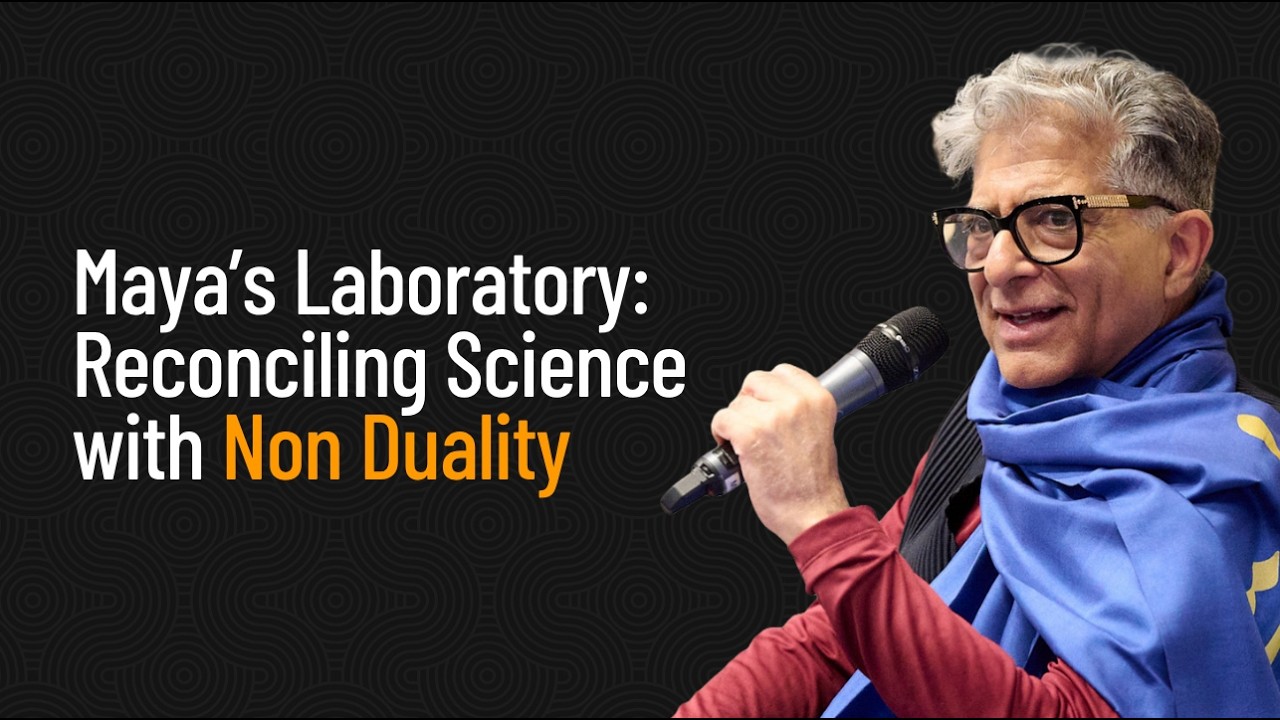
The index carries the two texts most associated with serious physicist engagement near this boundary: Bohm's Wholeness and the Implicate Order and Schrödinger's essays. For the popularising end, Deepak Chopra is the most represented figure. Quantum Healing remains his best-known book in this vein, and the talk *Maya's Laboratory: Reconciling Science with Non-Duality* is among the entries where he addresses the relationship between physics and consciousness most directly. The morphic resonance hypothesis, which proposes memory-like fields that accumulate across a species, operates in adjacent territory: it borrows field-physics language to describe phenomena that standard biology does not accept. Quantum mysticism in the strict sense is largely a phenomenon of written popularisation rather than live teaching; the teachers in the non-duality tradition most represented in the index tend to ground their work in direct inquiry rather than in physics claims.