What is Shams of Tabrīz?
Shams al-Dīn al-Tabrīzī (c. 1185–c. 1248) was a wandering Sufi dervish from north-western Iran whose three years of companionship with Rumi in Konya from 1244 transformed an established Hanafi jurist into the poet of the Dīvān-e Shams-e Tabrīzī and the *Masnavī*. He left his own teaching only in the Maqālāt, the Discourses. His disappearance from Konya, and Rumi's poetry in response to it, made him one of the most influential figures in the Sufi tradition.
Shams of Tabrīz vs adjacent concepts
Shams is not Rumi's teacher in the institutional sense the South Asian ṭarīqa lineages later made standard. No formal initiation is recorded between them. What the sources describe looks more like the meeting of two unusually formed contemplatives than a master-disciple transmission.
Shams is also not the wisdom-teacher of the contemporary popular market. Several books circulate under his name as the forty rules of love or secret teachings. None of these correspond to any text in the Persian sources. The Maqālāt the historical Shams left does not match their register.
And the figure of Shams in Rumi's Dīvān is not the Tabrīzī dervish. He is a composite: Shams, the sun, the friend, the beloved, the divine. In the ghazal tradition, the human beloved and the divine beloved are the same figure. The poetry is not biography.
Origins and the wandering years
He was born around 1185 in Tabrīz, in north-western Iran, to a family of probably Azerbaijani-Turkic descent. His exact lineage is unrecoverable. The early biographies — principally the Manāqib al-ʿĀrifīn of Aflākī, compiled some seventy years after his death — treat his pre-Konya years in deliberately mythic register.
What can be reconstructed: he received an unusually rigorous Qurʾānic and juridical education. He attached himself in his youth to Abū Bakr Salla-bāf of Tabrīz, a Sunni teacher about whom the sources say little. He then spent the four decades before his arrival in Konya as a wandering dervish, moving across the eastern Islamic world — Damascus, Aleppo, Baghdad, the Anatolian frontier towns — without belonging to any of the established ṭuruq the Mediterranean lodges had crystallised by the thirteenth century.
This mode of life was unusual enough that the chroniclers noted it. In some early sources he carries the appellation parinda, the flier. The character the Maqālāt transmits is consistent with this: unsparing in conversation, indifferent to social register, hostile to religious authority derived from formal credential rather than direct recognition.
The encounter with Rumi
Shams arrived in Konya at the end of November 1244. Within days he encountered Rumi, then a respected Hanafi jurist in his late thirties: professor at the family madrasa, leader of Friday prayer. The sources record the exact form of their meeting in three irreconcilable versions and its effect unanimously.
Within weeks Rumi had abandoned his teaching and his juridical work, withdrawn from public prayer, and entered a period of intense seclusion with Shams that lasted, with interruptions, until Shams's disappearance in late 1247 or early 1248.
The substance of what passed between them is not directly recoverable. The conversations were largely private. The Maqālāt preserves Shams's side only in late and partial form. Rumi's Dīvān-e Shams, the twenty-six thousand couplets composed in Shams's name across the rest of his life, is lyric record rather than transcript.
What can be said: the Maqālāt shows a teacher operating in the intoxicated Sufi register that Junayd's sober synthesis had pushed to the margins. The ecstatic-utterance lineage of Mansūr al-Ḥallāj and Abū Yazīd al-Bisṭāmī runs through it directly, without the doctrinal hedging Baghdad had insisted on. The Dīvān-e Shams shows what three years of direct exposure to that register did to a man who had spent his whole prior life inside the careful jurisprudential apparatus the lodges had built to contain it.
The transformation Konya recorded was not from Islam to mysticism. Rumi remained an orthodox Sunni jurist to the end. It was a movement to a depth of the tradition that Shams, in person, had made undeniable.
Disappearance and the lyrical record
Shams disappeared from Konya for the second and final time in late 1247 or early 1248. Three competing accounts survive. The Manāqib of Aflākī records that he was murdered by Rumi's jealous students, naming Rumi's son ʿAlāʾ al-Dīn among the conspirators. Rumi's elder son Sultan Walad maintained that Shams simply left without explanation. A third account holds that he returned to Khoy in north-western Iran, where a fourteenth-century mausoleum survives. The modern scholarly consensus, surveyed most fully in Franklin Lewis's Rumi: Past and Present, East and West (2000), is that the historical question is unanswerable from the available sources.
What is documented is the effect on Rumi: the writing of the Dīvān in Shams's name, the eventual founding of the Mevlevi ṭarīqa through Rumi's successor Ḥüsamettin, and the samāʿ — the whirling ritual — that the order organised around as an embodied form of *fanāʾ*.
The figure Shams becomes in Rumi's verse is not the historical man the Maqālāt records. He is a composite: Shams, the sun, the friend, the beloved, the divine. The Konya teacher and the absolute he is taken to have made available are not separable in the poetry. This is partly how the ghazal form works: the beloved in Persian Sufi poetry is conventionally both the human friend and the divine simultaneously, with each surface image serving as a theological cipher. It is also the specific shape of what Rumi was trying to record. The Shams of the Dīvān is the Konya teacher made into the doctrinal vehicle the Persianate Sufi tradition has used him as ever since.
Where to encounter Shams in the index
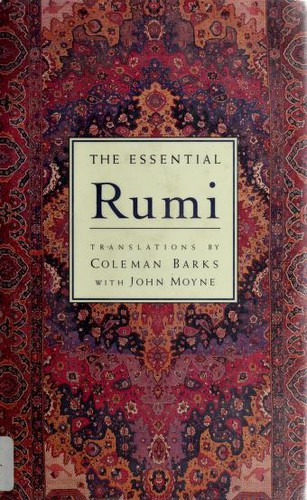
The English-language material in the index approaches Shams through Rumi. Coleman Barks's *The Essential Rumi* is the principal Anglophone gateway. The volume opens with material from the Dīvān-e Shams and returns repeatedly to the figure of the friend the lyrics name. Barks's introductions give the reader a serviceable orientation to the Konya encounter and its consequence.
Barks's *Rumi: Bridge to the Soul* carries the same lyric material in a later selection. His audiobook reading preserves the performative register the poems were composed for. *Rumi: Voice of Longing* reads from the Dīvān sequences in which the longing for the absent friend is most extended. The longer Coleman Barks Rumi audio collection gives the broadest selection across both the Dīvān and the *Masnavī*.
The reservations that apply to Barks's translations generally — looseness with the Persian original, stripping of the Islamic frame, free assembly of ghazal fragments — apply with particular force to the Shams material. The historical figure is already partially constructed in Persian; the English filtration adds another layer. For the Konya encounter at scholarly resolution, the reader reaches for Franklin Lewis's biographical chapters, the William Chittick translation of the Maqālāt (Me & Rumi: The Autobiography of Shams-i Tabrīzī, 2004), and the Reynold Nicholson and Annemarie Schimmel translations of the Dīvān.
The neighbouring Rumi, Mevlevi, Masnavī and Coleman Barks entries cover the surrounding territory.
What he isn't
Shams is not the wisdom-teacher the contemporary popular market has constructed from his name. Several titles purport to give his forty rules of love or his secret teaching — the most influential being Elif Shafak's 2010 novel The Forty Rules of Love. None of the forty rules circulating under his name correspond to any text in the Persian sources. The Maqālāt the historical Shams left does not match their register.
He is also not Rumi's [guru](lexicon:guru) in the institutional sense. No formal initiation is recorded between them. No organised teaching protocol was transmitted. What the sources record looks more like the meeting of two unusually formed contemplatives than the master-disciple structure the established orders had stabilised.
And the figure that survives in the Dīvān is not the Tabrīzī dervish but Rumi's literary reconstruction of him. The careful reader holds the two figures separately: the historical man whose conversations the Maqālāt partially preserves, and the doctrinal-lyrical figure the Konya encounter made of him. They are not the same.