What is Interior Castle?
The Interior Castle (El Castillo Interior) is a 1577 work of Christian mysticism by Teresa of Ávila. It maps the soul as a crystal castle of seven concentric dwellings, guiding the contemplative from ordinary prayer through progressively deeper stages of contemplative prayer to union with God. Written in five months while co-reformer John of the Cross was imprisoned in Toledo, and published posthumously in 1588, it is the principal pastoral text of the Spanish Carmelite school.
Composition and the castle metaphor
Teresa composed El Castillo Interior between June and November 1577 at the Discalced convent of San José in Toledo. She wrote it on the instruction of her confessor Jerónimo Gracián and the Dominican Diego de Yanguas. Both were anxious that her earlier Vida had been seized by the Inquisition, and wanted a fresh exposition of her teaching without the personal narrative the Holy Office had found troubling. The animating image came, by her own account, in a Trinity Sunday vision: the soul as un castillo todo de un diamante o muy claro cristal — a castle made entirely of a single diamond or very clear crystal, with many rooms inside. The dwellings are concentric rather than linear. The soul moves inward toward the central room where the King dwells, passing through seven graded regions of interiority. Teresa was writing in the immediate aftermath of John of the Cross's seizure by the Calced friars and his nine-month confinement in Toledo. The two works are companion documents of the same year: John's lyric of the dark passage, Teresa's prose map of the territory it crosses.
The seven dwellings
The first three moradas cover the early stages of contemplative life: entry into self-knowledge (conocimiento propio), withdrawal from distraction, and the disciplined practice of vocal and meditative prayer conducted under the practitioner's own effort. The fourth morada marks a threshold. The oración de quietud — prayer of quiet — is something the soul receives rather than produces. Divine action becomes the main factor for the first time. The fifth dwells on the oración de unión and on Teresa's celebrated image of the silkworm spinning its cocoon and emerging as a white butterfly, her emblem for the transformation that union begins. The sixth is the longest and the most difficult: the desposorio espiritual — spiritual betrothal — brings raptures, locutions and visions, but also the sharpest trials, including the abandono in which all sense of God's presence is withdrawn. The seventh is the matrimonio espiritual, spiritual marriage. In Teresa's spare formulation, the soul queda hecha una cosa con Dios — remains made one thing with God — while keeping its individual existence and its obligation to works in the world.
Where the work is encountered in the index
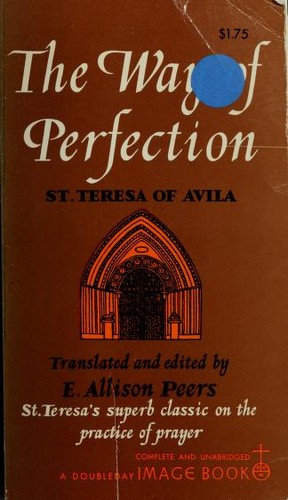
The Interior Castle is in the index in the E. Allison Peers translation, in use since 1946 and still the version used by the Carmelite Order's English-language formation curriculum. The companion Teresa works are also carried: The Way of Perfection, her teaching manual on the Pater Noster written for the nuns of the reform, and The Book of Her Life, the autobiographical text the Inquisition impounded and the first-person source for the doctrine the Castillo later abstracts. John of the Cross's *The Living Flame of Love* is the companion poem and prose commentary from the same school. The contemporary descent runs through Thomas Keating's *Open Mind, Open Heart*, the Centering Prayer Course and Keating's long-form talk on the practice. Centering prayer is presented by its founder as a method derived from *The Cloud of Unknowing* and from the Carmelite school, of which the Castillo is the principal pastoral document. Thomas Merton's *New Seeds of Contemplation* and *Thoughts in Solitude* carry the same inheritance into twentieth-century Trappist register, with Teresa cited as an operating authority. Richard Rohr's *The Naked Now* and his conversation with Krista Tippett on contemplation treat the Carmelite matrimonio espiritual, the Sufi fanāʾ-baqāʾ couplet, and the apophatic inheritance as recognisable siblings. Most twentieth-century Catholic writers on prayer take the Castillo as one of their primary references, whether or not they cite it directly.
Reception and the question of orthodoxy
Teresa wrote the Castillo aware that her texts were being read by the Inquisition. Early circulation was manuscript-only and tightly chaperoned: the autograph was held by Gracián, copied by a small set of trusted nuns, and not committed to print until Luis de León's posthumous Salamanca edition of 1588, six years after her death. The Spanish theological climate of the 1570s was hostile to alumbradismo, the family of interiorist movements the Inquisition had been suppressing since the 1520s. Teresa's account of infused prayer, of divine action experienced directly by the soul without mediation of the discursive faculties, sat close to the suspect register. Her formulations are hedged throughout with appeals to the authority of confessors, letrados, and the Roman magisterium. The hedging is not insincere: the Castillo is consistently Catholic in its doctrinal framing, and the seventh dwelling is explicit that the soul is not absorbed into God in the way certain readings of Meister Eckhart's German sermons had been condemned for proposing. Paul VI declared Teresa a Doctor of the Church in 1970, the first woman so designated. The Castillo was one of the two texts on which the designation was made.
Interior Castle vs related texts
The Castillo is not an autobiography. That work is the earlier Libro de la Vida, and Teresa was explicit that the Castillo should be teaching addressed to her sisters rather than another account of her own spiritual experiences. It is not systematic theology in the scholastic register: Teresa was unschooled in Latin, did not read the Patristic literature in the original, and the work proceeds by image and cumulative re-description rather than by argument. The seven moradas are not a rigid ladder. Teresa is repeatedly clear that the soul can move between dwellings, that the lower rooms are not vacated when the higher are entered, and that the whole structure describes simultaneous regions rather than a temporal sequence of stages. It is not a mystical text in the sense that conflates contemplation with ecstatic experience. Teresa is sceptical of the soul that takes raptures and visions as the index of progress. The sixth morada devotes extended attention to discreción de espíritus — discernment of spirits — by which genuine consolation is distinguished from what the soul confects for itself. The principal warning the text issues: the most consequential interior gifts are not the dramatic ones, humility is the operative criterion, and spiritual marriage is recognised by its fruit in works rather than by the intensity of any internal experience.