What is Shōbōgenzō?
The Shōbōgenzō (Treasury of the True Dharma Eye) is a collection of ninety-five fascicles written by Dōgen (1200–1253), founder of the Japanese Sōtō Zen school. Composed between 1231 and his death in 1253, it is the primary doctrinal text of the Sōtō lineage and one of the most studied premodern East Asian texts in twentieth-century philosophy.
Dōgen wrote almost entirely in middle Japanese, a deliberate departure from the classical Chinese his predecessors used. The work runs to ninety-five fascicles in the most complete extant edition. Some are transcriptions of oral teaching; others are dense doctrinal compositions worked at over months. The earliest fascicle, the Bendōwa (Talk on the Wholehearted Practice of the Way), is from 1231. The Genjōkōan (Manifesting Suchness) followed in 1233. The latest fascicles date to 1253, the year of Dōgen's death. Surviving manuscripts date to the late thirteenth and early fourteenth centuries. The medieval seventy-five-fascicle edition, the separately compiled twelve-fascicle edition, and the modern ninety-five-fascicle synthesis coexist as alternative arrangements within the Sōtō tradition.
Shōbōgenzō vs. other Zen texts
The Shōbōgenzō is often named alongside other foundational Zen texts, but it is different in kind. Koan collections compile cases with commentary designed for teacher-student exchange; the Shōbōgenzō is a doctrinal corpus, not a case collection. The Platform Sūtra of Huineng teaches sudden awakening for a broad audience; the Shōbōgenzō is addressed to monastics already inside formal practice and assumes that context throughout. It was not written for general readers and does not work well outside the curriculum it presupposes.
The central argument
The Shōbōgenzō is built on one central claim: practice and realisation are not two separate things. In Japanese, shushō ittō. Dōgen argues against the standard view in the Tendai and Rinzai literature of his day. On that view, sitting is a means toward awakening: you sit in order to attain a state you do not yet have. His counter is that Buddha-nature is not a hidden potential to be uncovered but the very condition that makes sitting possible at all. Sitting is not a path to awakening but awakening expressing itself. The fascicles that carry this argument most directly are the Bendōwa (1231), the Genjōkōan (1233), the Zazenshin (the Sitting Acupuncture-Needle), and the Fukan Zazengi (Universally Recommended Instructions for Zazen, 1227). The most-quoted lines in the corpus are from the Genjōkōan: to study the Buddha way is to study the self; to study the self is to forget the self; to forget the self is to be actualised by the myriad things.
The range of the fascicles
Most doctrinal corpora keep to a narrow range. The Shōbōgenzō does not. The Uji fascicle is a treatise on time and being. Its argument that being is time and time is being has drawn comparisons to Heidegger and Wittgenstein from twentieth-century commentators. The Sansuikyō treats mountains and waters as the unmediated speaking of dharma. The Raihai Tokuzui argues for the doctrinal authority of women teachers, against both the lineage's institutional practice and the contemporary Chinese position. The Tenzo Kyōkun is a manual on running a monastic kitchen, where preparing rice and pickles is treated as exactly the same practice as seated meditation. The Genjōkōan, the standard entry-point at fewer than two thousand characters, sits beside the Busshō (Buddha-Nature) fascicle, which runs to many times its length. The prose is recursive and almost untranslatable. Dōgen routinely re-reads classical Chinese phrases in non-standard ways to extract a Japanese meaning the original would not carry, and the wordplay is as much the argument as the surface sense.
Where it appears in the index
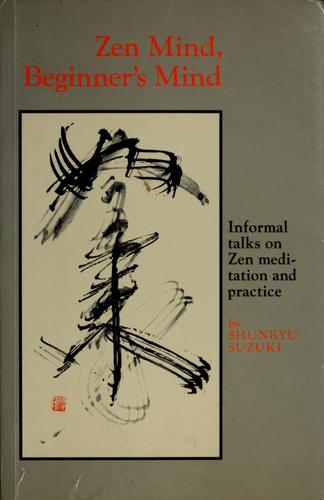
The lineage works downstream of the Shōbōgenzō rather than through it directly. Shunryū Suzuki's *Zen Mind, Beginner's Mind* carries Dōgen's core instruction in plain American English, without quoting the source at length. D. T. Suzuki's *An Introduction to Zen Buddhism* and his *Manual of Zen Buddhism* cover the broader Chan-to-Japanese-Zen transmission Dōgen sits inside. Kazuaki Tanahashi's *Zen and Nonduality* carries the voice of the principal living English translator of the work. His two-volume Treasury of the True Dharma Eye is the standard reference edition in English. Alan Watts on the *Way of Zen* traces the lineage from Bodhidharma's arrival in sixth-century China through the Platform Sūtra of Huineng into Dōgen's Eihei-ji in one readable arc. Adyashanti's *Do Nothing* is the clearest contemporary transmission of the practical instruction the Shōbōgenzō is built to defend. Fourteen years of formal training in the Maezumi-roshi line stand behind it, even when the Japanese vocabulary has dropped away.
What the Shōbōgenzō is not
The Shōbōgenzō is not a practical guide to Zen in the contemporary self-help register. The voice is technical, the syntax recursive, the cultural-grammatical assumptions thick. Most English readers approaching it without a Sōtō teacher and without prior training in classical East Asian textual conventions do not get past the second fascicle. It is not a single book in the modern sense: there is no continuous argument running through the ninety-five fascicles, no narrative arc, no terminating conclusion, and the order in which the fascicles are read is disputed within the Sōtō tradition. The text is also not, despite the commonplace, Zen philosophy. Dōgen rejects any framing in which doctrine could be separated from the seated practice the doctrine articulates. His prose is constructed to refuse the abstractive reading the philosophy-of-religion register would impose. The work was written by a sitting teacher for sitting students inside a curriculum the text presupposes.