What is the Platform Sūtra?
The Platform Sūtra (Liùzǔ Tánjīng) is the foundational scripture of the Southern School of Chinese Chán Buddhism. It is attributed to the Sixth Patriarch Huineng (638–713). Its central teaching is sudden awakening: the immediate seeing-into-one's-own-nature, in Chinese jiàn xìng chéng fó. This is the text where that doctrine takes its canonical form, and the source from which the East Asian Zen, Korean Sŏn and Vietnamese Thiền lineages descend.
How it differs from the Diamond, Lankāvatāra and Shōbōgenzō
The Platform Sūtra is often confused with three Mahāyāna texts that sit near it in the Chán canon. It differs from each. The *Diamond Sūtra* is an Indian Prajñāpāramitā discourse, and its line abide nowhere and let the mind arise is the provocation the Platform Sūtra builds on. But the Diamond is a discourse of the Buddha on emptiness, while the Platform is a Chinese patriarch's sermon on how awakening is recognised. The *Lankāvatāra Sūtra* was the doctrinal anchor of the Northern School of Shenxiu, the gradual rival the Platform displaces; the Platform effectively writes the Lankāvatāra's gradualism out of the patriarchal lineage. Dōgen's thirteenth-century *Shōbōgenzō* is the most influential later re-elaboration of the Platform's meditation-and-wisdom-as-one doctrine, in a Japanese Sōtō register. It is a re-reading of the Platform, not a rival to it.
The text, its versions and its history
The Liùzǔ Tánjīng, the Platform Sūtra of the Sixth Patriarch (sometimes rendered Platform Scripture or Altar Sūtra), is the foundational document of the Southern School of Chinese Chán Buddhism. It is the only work originally composed in Chinese to carry the title sūtra in the East Asian canon. The text survives in three main recensions, and the relationship between them has occupied twentieth-century philology. The earliest is the Dunhuang manuscript, recovered from the sealed library cave at Mogao in 1900 and dated to roughly 780 CE; it preserves what the text looked like within a few decades of its composition. The Hui Hsin recension, produced around 967 CE, expands that earlier text. The standard Zōngbǎo recension was redacted by the monk of that name in 1291 under the Yuan. It became the canonical form, circulated through the Ming, Qing and later printings, and it is the version most English translations rest on. The three differ mainly at the margins: the Dunhuang is the leanest, the Zōngbǎo the most elaborated. Comparing them has been one of the main lines of twentieth-century Chán scholarship. It began with Suzuki's 1934 critical edition of the Dunhuang manuscript and continued through Philip Yampolsky's 1967 scholarly study and Morten Schlütter's more recent work on the editorial history.
The narrative and the verse contest
The text's first chapters give a hagiographical account of Huineng's rise, which the school treats as both biography and doctrine. It opens with an orphan from Xinzhou, illiterate and working as a woodcutter to support his widowed mother. In a marketplace he overhears a recitation of the Diamond Sūtra and is seized by the line abide nowhere and let the mind arise. He travels north to the Fifth Patriarch Hongren's monastery on Mount Huangmei, where he is set to pounding rice in the threshing shed and kept out of the formal monastic curriculum. Hongren then proposes a verse contest to choose his successor. The head monk Shenxiu composes the gradual verse that the Northern School would later carry as its banner: the body is the bodhi tree, the mind a clear mirror; polish it constantly, let no dust gather. Huineng hears the verse recited. Unable to write, he dictates a reply: bodhi has originally no tree, the bright mirror has no stand; from the beginning there is not a single thing, where could the dust gather. The Fifth Patriarch recognises in this second verse the awakening the whole curriculum is built to provoke. He transmits the robe and bowl of patriarchal succession to Huineng at midnight and tells him to flee south. In that moment, as the text tells it, the Southern School is founded. The verse contest is the text's pedagogical signature. Shenxiu's gradual polishing and Huineng's sudden recognition are set up not as two techniques but as a doctrinal opposition, and the Platform Sūtra settles it in favour of the sudden in every later chapter.
The teaching: sudden awakening, no-thought, formless precepts
The doctrine is delivered in the long sermon and question-and-answer material that fills the central chapters. Its most-cited move is to reject the meditation-as-polishing idea that Shenxiu's verse stands for. The Platform Sūtra holds that one's own nature is already complete and already wisdom. This is zì xìng, the self-nature, the inherent buddha-nature. Practice does not build the awakened mind; it simply recognises what is already the case. The sermons coin three terms for this immediacy. Wú niàn, no-thought, is not the suppression of thinking but the refusal to grasp arising thought as solid. Wú xiàng, no-form, applies the same non-grasping to perception. Wú zhù, non-abiding, is the abide nowhere of the Diamond Sūtra line that first seized the young woodcutter. The most-quoted formula in the text's later reception is jiàn xìng chéng fó, see one's nature, accomplish buddhahood. It states the doctrine in four characters: the path turns on recognition, not gradual accumulation. The text also introduces the formless precepts (wú xiàng jiè). Here the threefold refuge in Buddha, dharma and sangha is reread as refuge in one's own nature, one's own wisdom, and one's own purity. Alongside it comes the meditation-and-wisdom-as-one doctrine (dìng huì bù èr), which argues against splitting samādhi and prajñā into separate trainings. These three moves are the Platform Sūtra's signature: the immediacy of seeing, the turning of the precepts inward, and the inseparability of meditation and wisdom. They are the source of how the whole patriarchal lineage later understood itself.
Where the text appears in the index
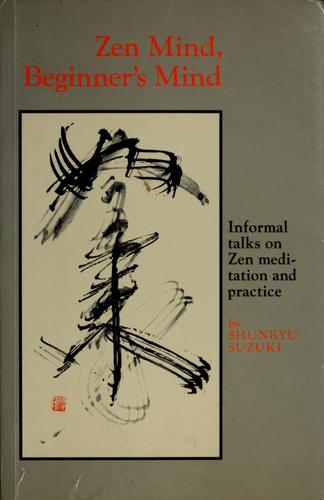
The Platform Sūtra itself is not yet in the index as a standalone translation. The Yampolsky scholarly edition and Red Pine's more recent translation remain the main English-language access, and may be added as items later. What the index does carry is the body of work that transmits the Platform Sūtra's doctrine into twentieth-century English. D. T. Suzuki's *An Introduction to Zen Buddhism* is where the Platform Sūtra first reached a wide Anglophone audience. Suzuki gives extended attention to Huineng's verse, to the sudden doctrine the Tánjīng canonises, and to the formless precepts; his 1934 Manual and 1932 Studies in the Lankavatara Sutra belong to the same project. His *Manual of Zen Buddhism* is the working compendium of texts and images he gathered around that effort. Alan Watts's *The Way of Zen* carries Suzuki's reading into a more discursive style. Watts argues that Huineng's sudden doctrine, not the gradual-cultivation approach of the Northern School it displaces, is what sets the East Asian Chán and Japanese Zen lineages apart from the Indian Buddhist meditative tradition they grew from. Shunryu Suzuki's *Zen Mind, Beginner's Mind* works inside the Sōtō descendant of the Platform doctrine. The shikantaza of Dōgen is a thirteenth-century re-elaboration of Huineng's meditation-and-wisdom-as-one, and the talks put its core move in plain English: the awakened nature is what is already sitting, and the sitting is not a means to it. Kazuaki Tanahashi's *Zen and Nonduality* reads the Platform Sūtra's self-nature doctrine alongside the non-dual inheritance of Advaita Vedānta; as Dōgen's principal English translator, his reading carries particular weight. Kaiten Nukariya's *The Religion of the Samurai*, a 1913 study still useful for its early Anglophone account of Chán doctrinal history, places the Platform Sūtra in the lineage chronology and treats Huineng's verse contest as the founding episode of the patriarchal school's self-understanding.
What it isn't
The Platform Sūtra is not a historical record of what the Sixth Patriarch actually taught. Twentieth-century scholarship (Yampolsky, Schlütter, Bernard Faure, John McRae) has established with reasonable confidence that the text was assembled by the school of Shenhui, Huineng's combative disciple, in the decades after the master's death. It was part of a sustained campaign to push the Northern School of Shenxiu out of the patriarchal succession at the Tang court. The verse contest, the midnight handover of the robe, the flight south, and the whole Southern versus Northern drama are best read as Shenhui-school propaganda. Whether their doctrinal content matches Huineng's actual teaching is unknown. This complicates the history but does not weaken the doctrine. The Platform Sūtra is the document under which the patriarchal lineage came to understand itself, and the Chán, Zen, Korean Sŏn and Vietnamese Thiền schools that descend from it work inside the framework it sets, whatever the historical Huineng taught. Despite its title, the text is also not a sūtra in the strict sense. It is the spoken teaching of a Chinese patriarch, not the discourse of a Buddha. Applying the word sūtra to it was the school's deliberate claim that its founding patriarch's teaching carries the same authority as the Buddha's. Finally, the sudden awakening it canonises does not mean the path requires no practice. The long monastic curricula of Sōtō, Rinzai, Sŏn and Thiền are plain evidence against the popular misreading that seeing one's nature makes the cushion redundant. The text's own line is the harder one: the awakened nature is already the case, and practice is the slow undoing of the obscurations that have kept it from registering.